

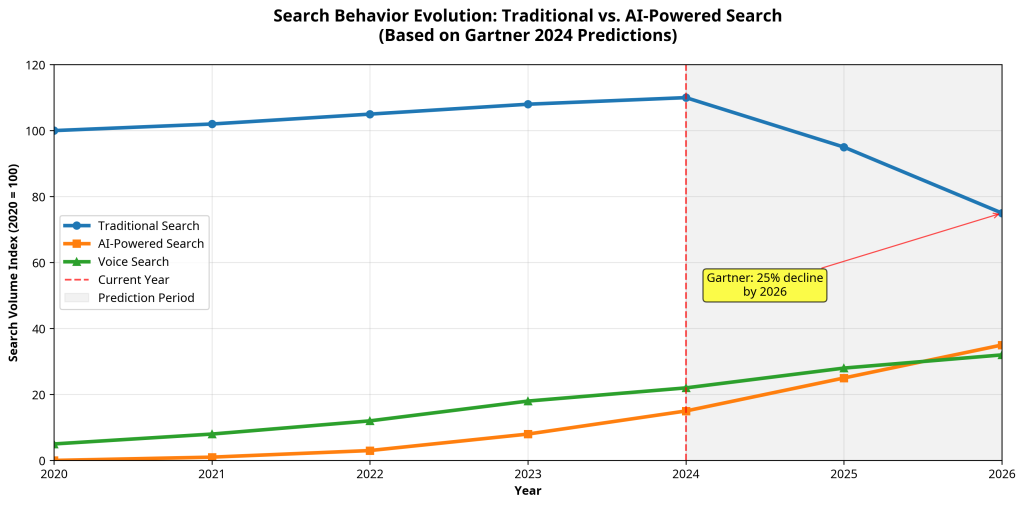
The search landscape is undergoing unprecedented transformation as artificial intelligence reshapes how users discover information. According to Gartner’s 2024 research, traditional search engine volume is projected to decline by 25% by 2026 due to AI chatbots and virtual agents [1]. Simultaneously, McKinsey’s analysis reveals that AI integration could boost marketing productivity by up to 15%, representing approximately $463 billion in potential savings [2]. Against this backdrop, Google’s Core Web Vitals have emerged as critical ranking factors, with specific performance thresholds now directly influencing search visibility [3]. This comprehensive analysis examines twelve advanced SEO tactics that enable organizations to maintain a competitive advantage while adapting to evolving search algorithms and user behaviors.
The Evolving SEO Landscape in 2025
Search engine optimization has entered a transformative period characterized by fundamental shifts in user behavior, technological capabilities, and algorithmic sophistication. The traditional paradigm of keyword-focused optimization is giving way to a more nuanced approach that prioritizes user experience, technical performance, and content quality. This evolution reflects broader changes in how people interact with digital information and the increasing sophistication of search algorithms in understanding user intent.
The most significant disruption comes from artificial intelligence integration across search platforms. Gartner’s comprehensive analysis indicates that traditional search engine volume will experience a 25% decline by 2026, primarily driven by the adoption of AI chatbots and virtual agents [1]. This prediction represents more than a statistical projection; it signals a fundamental shift in information discovery patterns that requires immediate strategic adaptation. Organizations that fail to recognize and respond to this transition risk losing substantial organic visibility and traffic.
Simultaneously, Google’s completion of mobile-first indexing has established mobile optimization as a non-negotiable requirement rather than a competitive advantage [4]. The search giant now uses the mobile version of websites for indexing and ranking decisions, fundamentally altering how content must be structured and presented. This shift reflects the reality that mobile devices now account for the majority of search queries, making mobile optimization essential for maintaining search visibility.
The introduction and refinement of Core Web Vitals as ranking factors represents another critical development. Google’s official documentation establishes specific performance thresholds: Largest Contentful Paint (LCP) must occur within 2.5 seconds, Interaction to Next Paint (INP) should be less than 200 milliseconds, and Cumulative Layout Shift (CLS) must maintain a score below 0.1 [3]. These metrics move beyond traditional SEO considerations to encompass user experience quality, creating direct connections between technical performance and search rankings.
| Year | Major Development | Impact on SEO Strategy | Adaptation Required |
|---|---|---|---|
| 2020 | Core Web Vitals Introduction | Performance becomes ranking factor | Technical optimization priority |
| 2021 | Mobile-First Indexing Completion | Mobile version determines rankings | Responsive design mandatory |
| 2022 | Helpful Content Update | Content quality emphasis | User-focused content creation |
| 2023 | AI Integration Acceleration | Search behavior changes | Conversational content optimization |
| 2024 | GenAI Search Features | Answer-focused results | Featured snippet optimization |
| 2025 | AI-First Search Experience | Traditional search decline begins | Multi-platform content strategy |
These developments create both challenges and opportunities for organizations seeking to maintain search visibility. The challenge lies in adapting established SEO practices to accommodate rapidly evolving requirements while maintaining performance across traditional metrics. However, organizations that successfully navigate this transition can achieve significant competitive advantages by capturing market share from competitors who fail to adapt adequately.
The opportunity extends beyond mere adaptation to encompass strategic positioning for future search behaviors. Early adoption of AI-optimized content strategies, comprehensive technical optimization, and user experience enhancement can establish sustainable competitive advantages. Organizations that view these changes as strategic imperatives rather than tactical adjustments are better positioned to thrive in the evolving search landscape.
Technical Foundation: Core Web Vitals and Performance Optimization
Technical SEO has evolved from a supporting role to become the foundation upon which all other optimization efforts depend. Google’s implementation of Core Web Vitals as ranking factors represents a paradigm shift that directly connects user experience quality with search visibility. This transformation requires organizations to approach technical optimization with the same strategic rigor traditionally reserved for content and link building initiatives.
Understanding Core Web Vitals: Official Thresholds and Measurement
Google’s Core Web Vitals framework establishes three fundamental metrics that quantify user experience quality across loading performance, interactivity, and visual stability dimensions [3]. These metrics move beyond subjective assessments to provide objective, measurable standards that directly influence ranking decisions. Understanding and optimizing for these metrics has become essential for maintaining competitive search visibility.
Largest Contentful Paint (LCP) measures loading performance by tracking the time required for the largest content element to become visible within the viewport. Google’s official threshold establishes 2.5 seconds as the maximum acceptable loading time for achieving “good” performance ratings [3]. This metric reflects user expectations for immediate content availability and directly correlates with engagement and conversion rates. Organizations consistently exceeding this threshold face both ranking penalties and user experience degradation that compounds over time.
Interaction to Next Paint (INP) replaced First Input Delay as the responsiveness metric, measuring the time between user interactions and visual feedback. The official threshold of 200 milliseconds represents the maximum delay users will tolerate before perceiving performance issues [3]. This metric captures the critical moment when users attempt to engage with content, making optimization essential for maintaining user satisfaction and preventing abandonment.
Cumulative Layout Shift (CLS) quantifies visual stability by measuring unexpected layout changes during page loading. Google’s threshold of 0.1 represents the maximum acceptable shift score for maintaining good user experience [3]. This metric addresses the frustrating experience of content moving unexpectedly, which can lead to accidental clicks and user dissatisfaction. Optimization requires careful attention to element sizing, font loading, and dynamic content insertion.
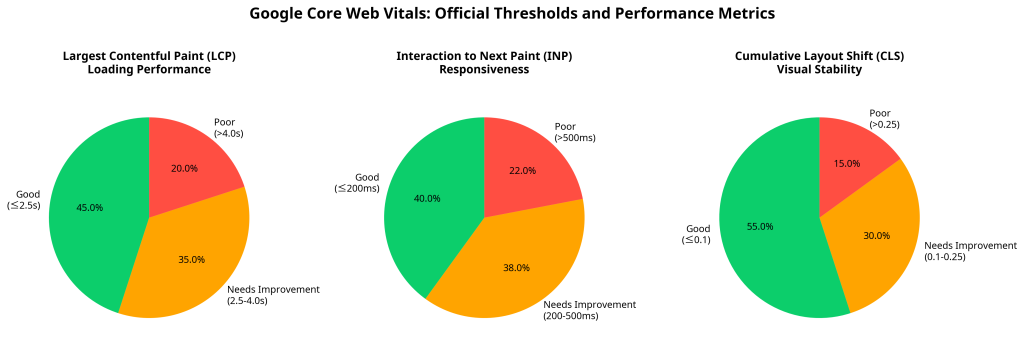
| Metric | Good Threshold | Needs Improvement | Poor Performance | Primary Measurement Tools |
|---|---|---|---|---|
| Largest Contentful Paint (LCP) | ≤ 2.5 seconds | 2.5 – 4.0 seconds | > 4.0 seconds | PageSpeed Insights, Search Console, Chrome DevTools |
| Interaction to Next Paint (INP) | ≤ 200 milliseconds | 200 – 500 milliseconds | > 500 milliseconds | PageSpeed Insights, Chrome UX Report, Real User Monitoring |
| Cumulative Layout Shift (CLS) | ≤ 0.1 | 0.1 – 0.25 | > 0.25 | PageSpeed Insights, Layout Instability API, Chrome DevTools |
Mobile-First Indexing: Implementation and Best Practices
Google’s transition to mobile-first indexing fundamentally altered how websites must be structured and optimized. The search engine now uses the mobile version of content for indexing and ranking decisions, making mobile optimization a primary rather than secondary consideration [4]. This shift reflects user behavior patterns where mobile devices account for the majority of search queries and website interactions.
Responsive design emerges as Google’s recommended approach for mobile optimization, serving identical HTML content across all devices while adapting presentation based on screen size [4]. This approach simplifies content management while ensuring consistency across platforms. However, implementation requires careful attention to performance optimization, as mobile devices often have limited processing power and network connectivity compared to desktop environments.
Content parity between mobile and desktop versions becomes critical under mobile-first indexing. Google’s official guidance emphasizes that mobile sites must contain equivalent content to their desktop counterparts, as the mobile version determines ranking potential [4]. Organizations that maintain separate mobile sites or significantly reduce content for mobile users risk losing search visibility for important keywords and topics.
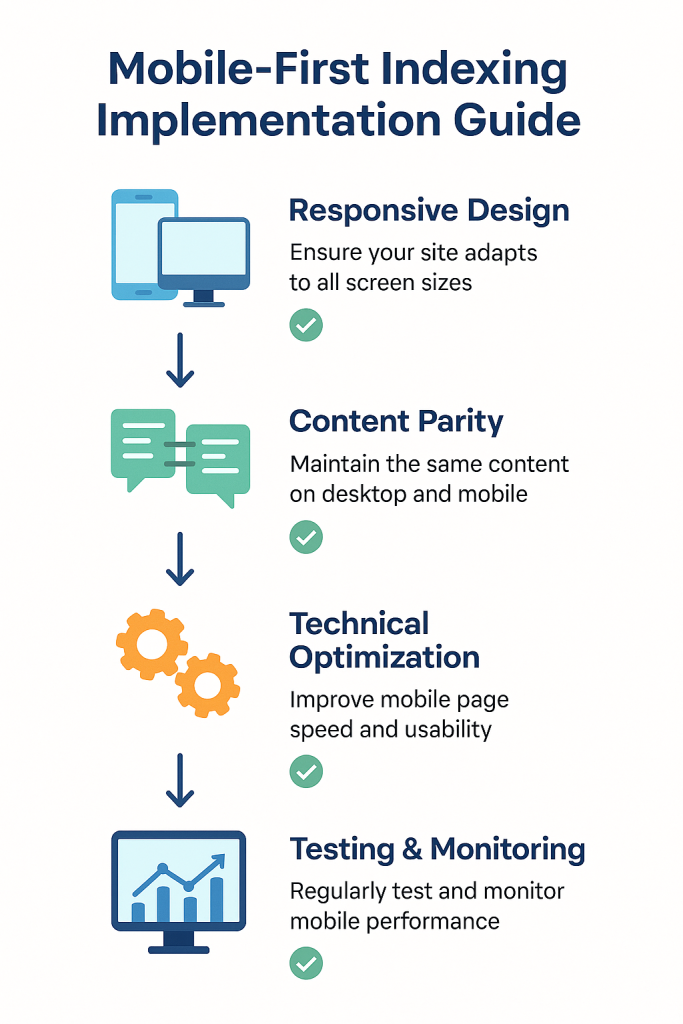
Technical implementation challenges often arise in areas such as structured data consistency, image optimization, and navigation functionality. Mobile sites must maintain identical structured data markup to ensure rich snippets and enhanced search features remain available [4]. Image optimization becomes particularly critical, as mobile users often have limited bandwidth and expect fast loading times despite potentially slower network connections.
Performance Optimization Strategies and Limitations
Achieving optimal Core Web Vitals performance requires systematic approaches that address both technical infrastructure and content delivery optimization. However, organizations must balance performance improvements with functionality requirements and resource constraints. Not all optimization techniques provide universal benefits, and some may create trade-offs that require careful evaluation.
Server response time optimization forms the foundation of performance improvement efforts. Implementing content delivery networks (CDNs), optimizing database queries, and utilizing efficient caching strategies can significantly improve LCP scores. However, these improvements require ongoing maintenance and monitoring to ensure sustained performance benefits. Organizations must also consider the costs associated with premium hosting solutions and CDN services when evaluating optimization strategies.
Image optimization presents both significant opportunities and implementation challenges. Modern image formats such as WebP and AVIF can reduce file sizes by 25-50% compared to traditional JPEG and PNG formats. However, browser compatibility considerations may require fallback strategies that increase implementation complexity. Additionally, responsive image implementation using srcset attributes can improve loading performance but requires careful planning to avoid increasing maintenance overhead.
JavaScript optimization often provides substantial performance improvements but may require significant development resources. Techniques such as code splitting, lazy loading, and critical resource prioritization can dramatically improve INP scores. However, these optimizations may introduce compatibility issues with older browsers or third-party integrations. Organizations must carefully evaluate the cost-benefit ratio of complex JavaScript optimizations, particularly when working with legacy systems or limited development resources.
Content Strategy: Advanced Keyword Research and On-Page Optimization
Content strategy in the modern SEO landscape requires sophisticated approaches that extend far beyond traditional keyword density optimization. The evolution of search algorithms toward semantic understanding and user intent recognition demands content strategies that prioritize relevance, comprehensiveness, and user value over mechanical keyword placement. This transformation creates opportunities for organizations that can effectively balance algorithmic requirements with genuine user needs.
Data-Driven Keyword Research: Beyond Basic Metrics
Contemporary keyword research must encompass multiple dimensions of user intent, competitive landscape analysis, and content gap identification. Traditional metrics such as search volume and keyword difficulty remain important, but they provide incomplete pictures of keyword opportunity and strategic value. Advanced keyword research integrates user behavior data, competitor content analysis, and semantic relationship mapping to identify high-value optimization targets.
High-intent keyword identification requires understanding the relationship between search queries and user actions. Keywords that indicate immediate purchase intent, such as “buy,” “price,” or “review” modifiers, typically generate higher conversion rates but also face increased competition. However, focusing exclusively on high-intent keywords can limit content reach and miss opportunities to engage users earlier in the decision-making process. Effective keyword strategies balance high-intent targets with informational and navigational queries that build brand awareness and authority.
Competitor keyword analysis provides insights into market opportunities and content gaps that can inform strategic positioning. Tools such as SEMrush and Ahrefs enable detailed analysis of competitor keyword rankings, content performance, and backlink profiles [5]. However, this analysis must extend beyond simple keyword identification to understand the content quality, user experience, and technical implementation that enables competitor success. Blindly targeting competitor keywords without understanding the underlying success factors often leads to ineffective optimization efforts.
Long-tail keyword strategies offer opportunities for organizations with limited domain authority to achieve meaningful search visibility. These longer, more specific queries typically face less competition while attracting users with clearer intent. However, long-tail optimization requires substantial content creation efforts and may not generate sufficient individual traffic to justify resource investment. Organizations must carefully evaluate the cumulative impact of long-tail strategies and ensure content quality remains high across all targeted keywords.
| Tool | Search Volume Data | Keyword Difficulty | Competitor Analysis | Content Gaps | Best Use Case |
|---|---|---|---|---|---|
| Google Keyword Planner | Accurate (ranges) | Limited | Basic | No | PPC campaign planning, basic research |
| SEMrush | Estimated | Comprehensive | Excellent | Yes | Competitive analysis, content strategy |
| Ahrefs | Estimated | Comprehensive | Excellent | Yes | Backlink analysis, keyword tracking |
| Moz Keyword Explorer | Estimated | Good | Good | Limited | Local SEO, SERP analysis |
| Google Search Console | Actual (limited) | No | No | No | Performance monitoring, optimization |
On-Page Optimization: Technical Implementation and User Experience
On-page optimization has evolved from simple keyword placement to comprehensive user experience enhancement that encompasses technical implementation, content structure, and engagement optimization. Modern on-page strategies must satisfy both algorithmic requirements and user expectations while maintaining scalability across large content inventories. This dual focus requires systematic approaches that can be implemented consistently without compromising content quality or user experience.
Meta title and description optimization remains fundamental to search visibility and click-through rate improvement. Effective titles must balance keyword inclusion with compelling messaging that encourages user engagement. Google’s title rewriting behavior, where the search engine modifies displayed titles based on query relevance, requires titles that remain effective even when altered [6]. This unpredictability necessitates title strategies that prioritize clarity and relevance over keyword stuffing or overly creative approaches that may confuse algorithmic interpretation.
Meta descriptions serve as advertising copy that influences click-through rates from search results. While not direct ranking factors, descriptions that effectively communicate page value and encourage clicks can improve overall search performance through increased engagement signals. However, Google frequently rewrites descriptions based on search queries, making it essential to include key information early in descriptions and ensure content quality supports any description Google might generate automatically.
Header tag structure provides both user experience benefits and algorithmic signals about content organization and hierarchy. Proper H1, H2, and H3 implementation helps users navigate content efficiently while providing search engines with clear signals about topic relationships and content structure [4]. However, header optimization must prioritize readability and logical flow over keyword density. Overoptimized headers that sacrifice user experience for algorithmic manipulation often result in poor engagement metrics that ultimately harm search performance.
Internal linking strategies create pathways for both users and search engines to discover and understand content relationships. Strategic internal linking can distribute page authority throughout a website while helping users find relevant information efficiently. However, excessive internal linking or irrelevant link placement can create poor user experiences and dilute the value of important links. Effective internal linking requires understanding user journey patterns and content relationships rather than mechanical link insertion based on keyword matching.
Content Quality and Freshness: Balancing Optimization with Value
Content quality assessment has become increasingly sophisticated as search algorithms develop better capabilities for evaluating user value and expertise. Google’s Helpful Content Update and E-A-T (Expertise, Authoritativeness, Trustworthiness) guidelines emphasize content that demonstrates genuine knowledge and provides meaningful value to users [7]. This evolution requires content strategies that prioritize subject matter expertise and user needs over traditional SEO metrics.
User intent alignment requires understanding the different types of information users seek and the context surrounding their searches. Informational queries require comprehensive, well-researched content that addresses user questions thoroughly. Navigational queries need clear, direct paths to desired information or functionality. Transactional queries benefit from detailed product information, comparison data, and clear conversion paths. Misaligning content with user intent, regardless of keyword optimization quality, typically results in poor engagement metrics and reduced search visibility.
Content updating and repurposing strategies can extend the value of existing content while improving search performance. Regular content audits can identify opportunities to refresh outdated information, expand thin content, and improve underperforming pages. However, content updates must add genuine value rather than simply changing publication dates or making superficial modifications. Search engines have become sophisticated at detecting low-value content updates that attempt to manipulate freshness signals without providing additional user value.
Data-driven content optimization requires systematic measurement and analysis of content performance across multiple metrics. Traditional SEO metrics such as rankings and organic traffic must be supplemented with user engagement data, conversion rates, and business impact measurements. This comprehensive approach enables identification of content that performs well algorithmically but fails to deliver business value, as well as content that generates strong user engagement but lacks search visibility. Balancing these different performance dimensions requires ongoing analysis and strategic adjustment rather than one-time optimization efforts.
Authority Building: Strategic Link Building and Content Creation
Authority building in contemporary SEO requires sophisticated strategies that extend beyond traditional link acquisition to encompass comprehensive brand building, relationship development, and content excellence. The evolution of search algorithms toward authority and trustworthiness evaluation means that sustainable SEO success depends increasingly on genuine expertise demonstration and community recognition rather than mechanical link building tactics.
Authoritative Backlink Acquisition: Quality Over Quantity
Modern link building strategies must prioritize relevance, authority, and natural acquisition patterns over volume-based approaches that dominated earlier SEO practices. Search engines have developed sophisticated capabilities for evaluating link quality, context, and acquisition patterns, making low-quality link building not only ineffective but potentially harmful to search performance. Successful link building requires understanding the factors that contribute to link value and developing sustainable approaches for earning high-quality references.
Domain authority and topical relevance have emerged as critical factors in link value assessment. Links from websites with established authority in relevant subject areas provide significantly more value than links from high-authority sites in unrelated industries. This shift requires link building strategies that prioritize industry-specific publications, professional associations, and subject matter expert websites over generic high-authority domains. However, identifying truly authoritative sources requires careful evaluation of content quality, audience engagement, and industry recognition rather than relying solely on automated metrics.
Link acquisition through relationship building and value provision represents the most sustainable approach to earning high-quality backlinks. This strategy involves identifying relevant websites and publications, understanding their content needs and audience interests, and developing resources that provide genuine value to their readers. However, relationship-based link building requires significant time investment and may not generate immediate results. Organizations must balance the long-term benefits of relationship building with the need for more immediate link acquisition to support competitive positioning.
Guest posting opportunities can provide valuable link building and brand exposure benefits when executed strategically. High-quality guest content on relevant, authoritative websites can establish thought leadership while earning valuable backlinks. However, guest posting faces increasing scrutiny from search engines, and low-quality guest posting practices can result in penalties. Successful guest posting requires focusing on content quality, audience value, and genuine expertise demonstration rather than link acquisition as the primary objective.
| Tactic | Potential Reward | Risk Level | Time Investment | Sustainability | Recommended Approach |
|---|---|---|---|---|---|
| Resource Page Outreach | High-quality relevant links | Low | Medium | High | Focus on genuine resource value |
| Guest Posting | Authority links + exposure | Medium | High | Medium | Prioritize content quality over volume |
| Broken Link Building | Relevant replacement links | Low | High | Medium | Provide superior replacement content |
| Digital PR Campaigns | High-authority media links | Low | High | High | Focus on newsworthy, data-driven content |
| Directory Submissions | Basic citation links | Medium | Low | Low | Limit to high-quality, relevant directories |
| Link Exchanges | Reciprocal link value | High | Low | Low | Avoid systematic exchanges |
Content Excellence and Thought Leadership
Content-driven authority building requires creating resources that demonstrate genuine expertise while providing substantial value to target audiences. This approach moves beyond traditional content marketing to encompass comprehensive resource development that establishes organizations as definitive sources of information in their respective fields. However, achieving this level of content excellence requires significant resource investment and sustained commitment to quality over quantity.
Original research and data analysis can establish thought leadership while generating natural link acquisition opportunities. Industry studies, survey results, and analytical insights provide valuable content that other websites naturally want to reference and link to. However, conducting meaningful research requires expertise, resources, and time that many organizations cannot easily allocate. Additionally, research-based content must be promoted effectively to achieve maximum visibility and link acquisition potential.
Comprehensive resource development involves creating detailed guides, tools, and educational materials that serve as definitive references for specific topics or processes. These resources often generate sustained link acquisition over time as they become recognized as authoritative sources. However, comprehensive resource creation requires substantial upfront investment and ongoing maintenance to ensure accuracy and relevance. Organizations must carefully evaluate the long-term value potential of resource development against the immediate costs and resource requirements.
Content updating and expansion strategies can extend the authority-building value of existing content while improving search performance. Regular content audits can identify opportunities to expand successful content, update outdated information, and improve underperforming resources. However, content improvement efforts must focus on genuine value enhancement rather than superficial modifications designed to manipulate freshness signals. Search engines have become sophisticated at detecting low-value content updates that attempt to game algorithmic preferences.
Relationship Building and Community Engagement
Sustainable authority building requires genuine engagement with industry communities, professional networks, and subject matter expert groups. This approach focuses on building authentic relationships and contributing valuable insights rather than pursuing transactional link acquisition opportunities. However, community engagement requires consistent participation and value contribution over extended periods, making it challenging for organizations with limited resources or expertise.
Industry conference participation and speaking opportunities can establish thought leadership while creating natural link acquisition opportunities through event websites, attendee blogs, and industry publications. However, securing speaking opportunities requires demonstrated expertise and often involves significant travel and time commitments. Organizations must evaluate the comprehensive benefits of conference participation, including networking, brand exposure, and potential business development, rather than focusing solely on link acquisition potential.
Professional association involvement and industry publication contributions can establish credibility while generating authoritative backlinks from relevant sources. Active participation in industry organizations often leads to content contribution opportunities, committee participation, and recognition that generates natural link acquisition. However, meaningful association involvement requires ongoing commitment and may not generate immediate SEO benefits. Organizations must view association participation as long-term brand building rather than short-term link acquisition strategy.
Link Profile Monitoring and Risk Management
Effective link building strategies must include comprehensive monitoring and risk management components to identify potential issues before they impact search performance. Google’s sophisticated link evaluation algorithms can identify and devalue low-quality or manipulative links, making proactive link profile management essential for maintaining search visibility. However, link profile analysis requires ongoing attention and expertise that many organizations struggle to maintain consistently.
Toxic link identification and disavowal processes provide protection against negative SEO attacks and historical link building mistakes. Regular link profile audits can identify potentially harmful links that should be disavowed through Google’s disavow tool. However, aggressive disavowal practices can accidentally remove valuable links, and the disavowal process itself can be complex and time-consuming. Organizations must balance proactive risk management with the potential for over-optimization that could harm beneficial link relationships.
Competitive link analysis can identify opportunities while providing insights into industry link building standards and practices. Understanding competitor link profiles can reveal potential link sources, content opportunities, and strategic positioning possibilities. However, competitive analysis must focus on understanding successful strategies rather than attempting to replicate competitor tactics without considering context, resources, and strategic fit. Blindly copying competitor link building approaches often leads to ineffective resource allocation and missed opportunities for differentiation.
Analytics and Monitoring: Data-Driven SEO Optimization
Data-driven SEO optimization requires sophisticated measurement frameworks that extend beyond traditional ranking and traffic metrics to encompass user behavior, business impact, and competitive positioning analysis. The complexity of modern search algorithms and user behavior patterns demands comprehensive analytics approaches that can identify optimization opportunities while measuring the effectiveness of implemented strategies. However, the abundance of available data can create analysis paralysis if not properly structured and prioritized.
Performance Tracking Tools and Integration Strategies
Effective SEO analytics requires integration of multiple data sources to create comprehensive performance pictures that inform strategic decision-making. Google Analytics and Search Console provide foundational data about organic traffic, user behavior, and search performance, but these tools must be supplemented with specialized SEO platforms to achieve complete visibility into optimization opportunities and competitive positioning. However, tool proliferation can create data management challenges and increase costs that must be carefully evaluated against analytical benefits.
Google Search Console serves as the authoritative source for search performance data, providing insights into keyword rankings, click-through rates, and technical issues that directly impact search visibility [8]. The platform’s Performance report enables detailed analysis of query performance, page effectiveness, and geographic variations in search results. However, Search Console data has limitations, including sampling for high-traffic sites and delayed reporting that can impact real-time optimization efforts. Organizations must understand these limitations when making strategic decisions based on Search Console data.
Third-party SEO platforms such as SEMrush and Ahrefs provide competitive intelligence and keyword tracking capabilities that complement Google’s official data sources [5]. These platforms enable comprehensive competitor analysis, keyword opportunity identification, and backlink monitoring that supports strategic positioning and content planning. However, third-party data is estimated rather than actual, and accuracy can vary significantly across different markets and keyword types. Organizations must validate third-party insights with official data sources before making significant strategic commitments.
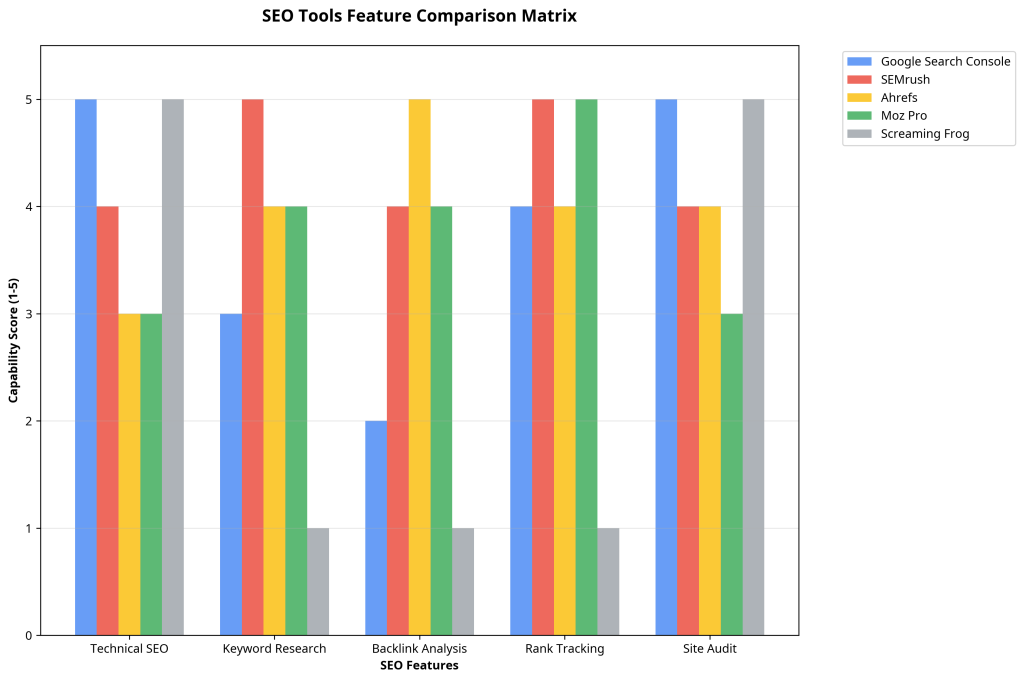
| Tool Category | Primary Function | Data Accuracy | Integration Complexity | Cost Considerations | Best Use Cases |
|---|---|---|---|---|---|
| Google Search Console | Official search performance data | Authoritative | Simple | Free | Performance monitoring, technical issues |
| Google Analytics 4 | User behavior and conversion tracking | Authoritative | Moderate | Free/Premium | User journey analysis, ROI measurement |
| SEMrush | Competitive analysis and keyword tracking | Estimated | Moderate | Subscription | Competitor research, content strategy |
| Ahrefs | Backlink analysis and keyword research | Estimated | Moderate | Subscription | Link building, competitive analysis |
| Screaming Frog | Technical SEO auditing | Comprehensive | Simple | Free/Premium | Site audits, technical optimization |
| PageSpeed Insights | Core Web Vitals measurement | Authoritative | Simple | Free | Performance optimization, UX analysis |
User Behavior Analysis and Optimization Opportunities
User behavior metrics provide critical insights into content effectiveness, user experience quality, and conversion optimization opportunities that traditional SEO metrics cannot capture. Understanding how users interact with content after arriving from search results enables identification of optimization opportunities that improve both search performance and business outcomes. However, user behavior analysis requires sophisticated interpretation skills and understanding of statistical significance to avoid making decisions based on misleading data patterns.
Bounce rate and time on page metrics provide insights into content relevance and user engagement quality, but these metrics must be interpreted within an appropriate context. High bounce rates may indicate poor content-query alignment, but they can also reflect successful information delivery for specific query types. Similarly, low time on page may suggest poor content quality or efficient information delivery, depending on user intent and content type. Effective analysis requires understanding the relationship between user intent, content type, and expected behavior patterns.
Conversion path analysis reveals how organic search traffic contributes to business objectives and identifies opportunities for optimization throughout the user journey. Understanding the role of organic search in multi-touch conversion paths enables more accurate ROI calculation and strategic resource allocation. However, attribution modeling complexity and cross-device tracking limitations can create incomplete pictures of organic search value. Organizations must acknowledge these limitations when evaluating SEO performance and making budget allocation decisions.
Page-level performance analysis enables identification of high-performing content that can be expanded or replicated, as well as underperforming content that requires optimization or removal. Systematic analysis of page performance across multiple metrics can reveal patterns that inform content strategy and optimization priorities. However, page-level analysis must consider factors such as seasonality, competitive changes, and algorithm updates that can impact performance independent of content quality or optimization efforts.
Competitive Intelligence and Market Positioning
Competitive analysis provides essential context for SEO strategy development and performance evaluation, enabling organizations to understand their relative positioning and identify strategic opportunities. However, competitive intelligence must extend beyond simple ranking comparisons to encompass content quality, user experience, and technical implementation analysis that explains competitive advantages and disadvantages. Superficial competitive analysis often leads to misguided optimization efforts that fail to address underlying strategic weaknesses.
Keyword gap analysis identifies opportunities where competitors achieve visibility for relevant terms while revealing potential content and optimization opportunities. Understanding competitor keyword strategies can inform content planning and identify market segments that may be underserved or overlooked. However, keyword gap analysis must consider factors such as content quality, user intent alignment, and resource requirements rather than simply targeting all competitor keywords. Indiscriminate keyword targeting often leads to thin content creation and resource waste.
Content performance comparison enables understanding of what types of content succeed in specific markets and how content quality standards have evolved over time. Analyzing competitor content that achieves strong search performance can reveal best practices and identify opportunities for differentiation. However, content analysis must focus on understanding success factors rather than copying competitor approaches without considering brand positioning, audience differences, and resource capabilities.
Technical implementation analysis reveals competitive advantages in areas such as site speed, mobile optimization, and structured data implementation that may not be immediately apparent from ranking analysis. Understanding competitor technical capabilities can identify optimization priorities and reveal potential competitive advantages. However, technical analysis requires expertise to interpret findings accurately and avoid implementing changes that may not be appropriate for different technical environments or business requirements.
Performance Measurement and ROI Calculation
Comprehensive SEO performance measurement requires frameworks that connect search optimization efforts with business outcomes while accounting for the complex, long-term nature of SEO results. Traditional metrics such as rankings and organic traffic provide important indicators but must be supplemented with business impact measurements to demonstrate value and guide resource allocation decisions. However, SEO ROI calculation faces challenges including attribution complexity, long optimization cycles, and difficulty isolating SEO impact from other marketing activities.
Revenue attribution from organic search requires sophisticated tracking and analysis capabilities that can connect search queries and landing pages with eventual conversions and business outcomes. Understanding the customer journey from initial search through conversion enables more accurate value calculation and optimization prioritization. However, attribution modeling complexity increases with business model sophistication, and cross-device tracking limitations can create incomplete revenue pictures. Organizations must acknowledge these limitations while working to improve attribution accuracy over time.
Cost-per-acquisition analysis for organic search enables comparison with other marketing channels and evaluation of SEO efficiency relative to paid alternatives. Understanding the true cost of organic traffic acquisition, including content creation, technical optimization, and tool expenses, provides essential context for budget allocation decisions. However, SEO cost calculation must account for the cumulative and long-term nature of optimization benefits that may not be captured in short-term analysis periods.
Lifetime value considerations become particularly important for SEO ROI calculation because organic search often attracts users earlier in the purchase cycle who may have higher long-term value than users from other channels. Understanding the relationship between search behavior, customer quality, and lifetime value can justify SEO investments that may not appear cost-effective based on immediate conversion metrics. However, lifetime value analysis requires sophisticated customer data and may not be feasible for organizations with limited analytics capabilities or short customer relationship cycles.
Visual Framework: Schema Markup and User Experience
The visual presentation of search results has evolved dramatically with the introduction of rich snippets, featured snippets, and enhanced search features that depend on structured data implementation and user experience optimization. Schema markup has transitioned from an optional enhancement to an essential component of comprehensive SEO strategy, directly influencing search visibility and click-through rates. However, schema implementation requires technical expertise and ongoing maintenance that many organizations struggle to manage effectively.
Schema Implementation: Types, Benefits, and Technical Considerations
Schema markup provides search engines with structured information about content, enabling enhanced search result displays that can significantly improve visibility and click-through rates. The Schema.org vocabulary includes hundreds of markup types, but practical implementation should focus on schemas that provide clear business value and align with content types and business objectives. However, schema implementation complexity varies significantly across different markup types, and incorrect implementation can potentially harm search performance rather than improve it.
Product schema markup enables rich product displays in search results, including pricing, availability, and review information that can dramatically improve e-commerce visibility. Proper product schema implementation can result in enhanced search listings that include star ratings, price ranges, and availability status directly in search results. However, product schema requires accurate, up-to-date information and compliance with Google’s merchant policies. Incorrect or misleading product information can result in rich snippet removal and potential ranking penalties.
Review schema markup allows businesses to display star ratings and review counts in search results, providing social proof that can significantly improve click-through rates. Aggregate rating displays can differentiate listings from competitors while building trust with potential customers. However, review schema implementation must comply with Google’s guidelines regarding review authenticity and representation. Manipulated or fake reviews can result in manual penalties and loss of rich snippet eligibility.
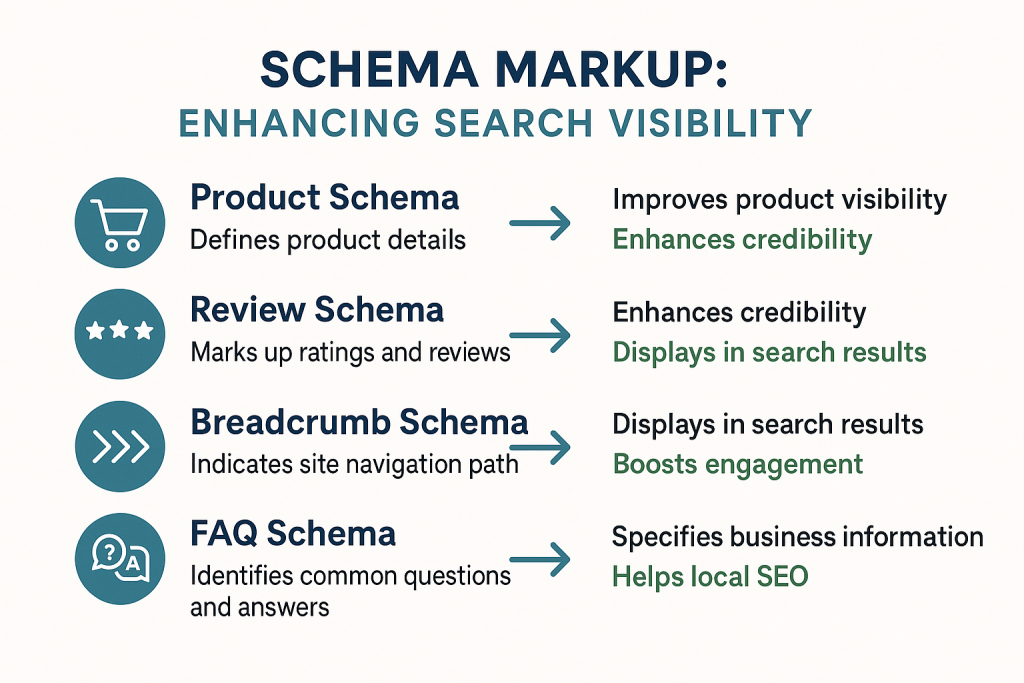
FAQ schema markup enables content to appear in featured snippets and answer boxes, providing opportunities to capture additional search real estate and address user questions directly in search results. Well-implemented FAQ schema can result in expanded search listings that answer multiple related questions, increasing visibility and establishing authority. However, FAQ schema requires high-quality, comprehensive answers that genuinely address user questions. Low-quality or manipulative FAQ implementation can result in schema removal and reduced search visibility.
Local business schema markup provides essential information for location-based searches, including business hours, contact information, and service areas. Proper local schema implementation can improve visibility in local search results and Google My Business integration. However, local schema requires accurate, consistent information across all online platforms and regular updates to maintain accuracy. Inconsistent local information can confuse search engines and harm local search performance.
Core Web Vitals and User Experience Optimization
User experience optimization has become inseparable from technical SEO as Google’s Core Web Vitals directly influence search rankings while impacting user satisfaction and conversion rates. The integration of user experience metrics into ranking algorithms reflects the search engine’s focus on delivering results that provide genuine value to users. However, user experience optimization often requires significant technical resources and may conflict with other business objectives such as advertising revenue or feature complexity.

Video: Google’s official explanation of Core Web Vitals metrics and their importance for user experience and search performance.
Loading performance optimization requires systematic approaches that address multiple factors, including server response times, resource optimization, and content delivery strategies. Achieving optimal Largest Contentful Paint (LCP) scores often requires significant technical changes including image optimization, critical resource prioritization, and caching implementation. However, performance optimization efforts must balance speed improvements with functionality requirements and may require ongoing maintenance to sustain benefits over time.
Interactivity optimization focuses on reducing delays between user actions and visual feedback, directly impacting user satisfaction and engagement. Achieving optimal Interaction to Next Paint (INP) scores requires careful JavaScript optimization, efficient event handling, and strategic resource loading. However, interactivity improvements may conflict with feature richness or third-party integrations that provide business value. Organizations must carefully evaluate trade-offs between performance optimization and functionality requirements.
Visual stability optimization addresses layout shifts that can frustrate users and harm conversion rates. Achieving optimal Cumulative Layout Shift (CLS) scores requires careful attention to element sizing, font loading strategies, and dynamic content insertion. However, visual stability optimization may limit design flexibility or require significant changes to existing layouts and functionality. Organizations must balance visual stability improvements with design requirements and user experience expectations.
Mobile Optimization and Responsive Design
Mobile optimization has evolved from a competitive advantage to a fundamental requirement as mobile-first indexing makes mobile user experience the primary factor in search ranking decisions. Responsive design implementation must address not only visual presentation but also functionality, performance, and user interaction patterns that differ significantly between mobile and desktop environments. However, comprehensive mobile optimization often requires substantial development resources and may impact desktop user experience if not carefully implemented.
Touch interface optimization requires understanding how mobile users interact with content and ensuring that navigation, forms, and interactive elements function effectively on touch devices. Mobile-specific considerations include button sizing, gesture support, and input method optimization that may not be relevant for desktop users. However, mobile optimization efforts must avoid creating inconsistent experiences across devices or compromising functionality for users who switch between mobile and desktop environments.
Mobile performance optimization faces unique challenges, including limited processing power, variable network connectivity, and battery life considerations that require specialized approaches. Mobile-specific optimization techniques include aggressive image compression, selective feature loading, and offline functionality that may not be necessary for desktop users. However, mobile performance optimization must balance speed improvements with functionality preservation and may require ongoing monitoring to ensure sustained performance across different devices and network conditions.
Progressive web app (PWA) implementation can provide mobile users with app-like experiences while maintaining web accessibility and search engine visibility. PWA features, including offline functionality, push notifications, and home screen installation, can significantly improve mobile user engagement. However, PWA implementation requires substantial technical expertise and may not provide benefits for all business types or user segments. Organizations must carefully evaluate PWA benefits against implementation costs and maintenance requirements.
Action Plan: Implementation Roadmap
Successful SEO implementation requires systematic approaches that prioritize high-impact activities while building sustainable optimization capabilities over time. The complexity of modern SEO demands structured implementation plans that can accommodate resource constraints while ensuring consistent progress toward strategic objectives. However, implementation timelines must remain flexible to accommodate algorithm changes, competitive responses, and evolving business priorities that can impact optimization strategies.
Phase 1: Technical Foundation (Weeks 1-2)
Technical foundation establishment provides the infrastructure necessary for all subsequent optimization efforts and should be prioritized to ensure that content and link building investments achieve maximum effectiveness. This phase focuses on identifying and resolving technical issues that could limit search visibility while implementing measurement systems that enable ongoing optimization monitoring. However, technical optimization often requires specialized expertise and may uncover additional issues that extend implementation timelines beyond initial estimates.
Core Web Vitals audit and optimization represents the most critical technical priority, as performance issues directly impact both user experience and search rankings. Comprehensive performance analysis should identify specific bottlenecks affecting LCP, INP, and CLS scores while developing prioritized improvement plans that address the most impactful issues first. However, performance optimization may require significant development resources and could impact other website functionality if not carefully planned and tested.
Mobile-first indexing compliance verification ensures that mobile versions of content provide equivalent value and functionality to desktop versions. This audit should identify content gaps, functionality limitations, and technical issues that could harm mobile search performance. However, mobile optimization may require substantial design and development changes that extend beyond simple responsive design implementation to encompass mobile-specific user experience considerations.
Technical SEO infrastructure setup includes implementing comprehensive tracking systems, establishing baseline performance measurements, and configuring monitoring tools that enable ongoing optimization efforts. This foundation enables data-driven decision making and provides early warning systems for technical issues that could impact search performance. However, analytics implementation complexity can create ongoing maintenance requirements and may require specialized expertise to configure and interpret effectively.
| Phase | Duration | Primary Focus | Key Deliverables | Success Metrics | Resource Requirements |
|---|---|---|---|---|---|
| Phase 1: Technical Foundation | Weeks 1-2 | Performance & Infrastructure | Core Web Vitals optimization, mobile compliance, analytics setup | Performance scores, mobile usability, tracking accuracy | Technical expertise, development resources |
| Phase 2: Content & Keywords | Weeks 3-4 | Content Strategy & Optimization | Keyword research, content audit, on-page optimization | Keyword rankings, content quality scores, user engagement | Content expertise, SEO tools, writing resources |
| Phase 3: Authority Building | Weeks 5-8 | Link Building & Relationships | Link acquisition, content promotion, relationship development | Quality backlinks, domain authority, brand mentions | Outreach expertise, content creation, relationship management |
| Phase 4: Monitoring & Optimization | Ongoing | Performance & Improvement | Regular reporting, optimization adjustments, strategy refinement | Traffic growth, conversion improvement, competitive positioning | Analytics expertise, ongoing optimization, strategic planning |
Phase 2: Content and Keywords (Weeks 3-4)
Content strategy development and keyword optimization provide the foundation for sustainable organic search growth while establishing topical authority that supports long-term competitive positioning. This phase focuses on identifying high-value optimization opportunities while developing content frameworks that can scale efficiently over time. However, content optimization requires balancing search engine requirements with user value creation, and poor execution can harm both search performance and user experience.
Comprehensive keyword research should identify optimization opportunities across the entire customer journey while considering competitive landscape dynamics and resource requirements for effective targeting. This research must extend beyond simple search volume analysis to encompass user intent evaluation, competitive difficulty assessment, and content gap identification that reveals strategic opportunities. However, keyword research accuracy depends on tool quality and market understanding, and targeting decisions must consider long-term strategic positioning rather than short-term traffic potential.
Content audit and optimization involves a systematic evaluation of existing content performance while identifying improvement opportunities that can generate immediate search visibility gains. This process should prioritize high-traffic pages with optimization potential while identifying thin or duplicate content that may be harming overall site performance. However, content optimization must maintain quality standards and user value while improving search performance, requiring a careful balance between optimization and user experience considerations.
On-page optimization implementation focuses on technical elements including title tags, meta descriptions, header structure, and internal linking that directly influence search visibility. These optimizations should follow established best practices while maintaining natural, user-focused content that provides genuine value. However, on-page optimization must avoid over-optimization that can harm search performance while ensuring that changes support rather than detract from user experience quality.
Phase 3: Authority Building (Weeks 5-8)
Authority building initiatives establish long-term competitive advantages through relationship development, content excellence, and strategic positioning that extends beyond traditional link building to encompass comprehensive brand building. This phase requires sustained effort and relationship investment that may not generate immediate results but provides essential foundation for sustainable search success. However, authority building efforts must balance resource investment with measurable outcomes while avoiding tactics that could harm brand reputation or search performance.
Strategic link building should focus on earning high-quality, relevant backlinks through value creation and relationship development rather than transactional link acquisition approaches. This strategy requires identifying authoritative sources within relevant industries while developing content and resources that naturally attract link references. However, link building success depends on content quality, relationship development skills, and industry positioning that may require significant time investment before generating measurable results.
Content creation and promotion efforts should establish thought leadership while providing resources that naturally attract links and social sharing. This approach requires developing comprehensive, original content that demonstrates expertise while addressing genuine user needs and industry challenges. However, content creation requires substantial resource investment and expertise while competing with established authorities that may have significant advantages in terms of audience, resources, and industry recognition.
Relationship building and community engagement provide sustainable foundations for ongoing authority development while creating opportunities for collaboration, content promotion, and natural link acquisition. This strategy requires genuine participation in industry communities and consistent value contribution over extended periods. However, relationship building requires significant time investment and may not generate immediate measurable results, making it challenging to justify resource allocation in competitive environments with immediate performance pressures.
Phase 4: Monitoring and Optimization (Ongoing)
Continuous monitoring and optimization ensure that SEO investments generate sustained returns while adapting to algorithm changes, competitive developments, and evolving user behaviors that can impact search performance. This phase establishes systematic processes for performance measurement, issue identification, and strategic adjustment that enable long-term optimization success. However, ongoing optimization requires sustained resource commitment and expertise that many organizations struggle to maintain consistently over time.
Performance monitoring systems should track comprehensive metrics including search visibility, user engagement, conversion performance, and competitive positioning while providing early warning systems for issues that could impact business outcomes. These systems must balance comprehensive coverage with actionable insights that enable effective decision making without creating information overload. However, monitoring system effectiveness depends on proper configuration, regular maintenance, and skilled interpretation that requires ongoing expertise and attention.
Regular optimization cycles should systematically identify improvement opportunities while testing and implementing changes that enhance search performance and user experience. These cycles must balance experimentation with proven strategies while avoiding changes that could harm existing performance. However, optimization effectiveness requires an understanding of search algorithm behavior, user preferences, and competitive dynamics that can change rapidly and unpredictably.
Strategic planning and adaptation processes ensure that SEO strategies remain aligned with business objectives while responding effectively to market changes, algorithm updates, and competitive developments. These processes must balance strategic consistency with tactical flexibility while maintaining focus on long-term objectives rather than short-term fluctuations. However, strategic adaptation requires comprehensive market understanding and decision-making frameworks that can accommodate uncertainty while maintaining strategic direction and resource allocation efficiency.
SEO Implementation Checklist: Essential Tasks and Verification Points
- Technical Foundation:
- ✓ Core Web Vitals performance audit completed
- ✓ Mobile-first indexing compliance verified
- ✓ Google Search Console and Analytics configured
- ✓ Site speed optimization implemented
- ✓ Technical SEO issues identified and prioritized
- Content Strategy:
- ✓ Comprehensive keyword research completed
- ✓ Content audit and gap analysis finished
- ✓ On-page optimization guidelines established
- ✓ Content calendar and production workflow created
- ✓ User intent mapping and content alignment verified
- Authority Building:
- ✓ Link building strategy and target list developed
- ✓ Content promotion and outreach processes established
- ✓ Industry relationship building initiatives launched
- ✓ Brand mention monitoring and management implemented
- ✓ Thought leadership content creation scheduled
- Monitoring Systems:
- ✓ Performance tracking dashboards configured
- ✓ Competitive monitoring systems established
- ✓ Regular reporting and review processes implemented
- ✓ Issue identification and response protocols created
- ✓ ROI measurement and attribution systems operational
Future Outlook: Preparing for AI-Driven Search
The search landscape is experiencing fundamental transformation as artificial intelligence reshapes how users discover information and how search engines deliver results. Gartner’s prediction of a 25% decline in traditional search engine volume by 2026 represents more than a statistical projection; it signals the emergence of new information discovery paradigms that require strategic adaptation from organizations dependent on organic search visibility [1]. Understanding and preparing for these changes has become essential for maintaining competitive positioning in an evolving digital ecosystem.
Emerging Trends and Technological Disruption
Artificial intelligence integration across search platforms is creating new user behaviors and expectations that challenge traditional SEO approaches. AI-powered search experiences prioritize direct answers and conversational interactions over traditional link-based results, fundamentally altering how content must be structured and optimized. However, this transition creates both risks for organizations dependent on traditional search traffic and opportunities for those who can adapt their content strategies to serve AI-powered discovery mechanisms effectively.
Generative AI search features are beginning to provide comprehensive answers directly within search results, potentially reducing click-through rates to individual websites while changing user expectations for information depth and immediacy. These features require content optimization strategies that focus on providing clear, authoritative information that AI systems can easily understand and reference. However, the impact of AI-generated search results on organic traffic remains uncertain, and organizations must balance optimization for AI systems with traditional search optimization requirements.
Voice search and conversational query patterns are becoming increasingly sophisticated as natural language processing capabilities improve and smart device adoption expands. These interactions require content optimization for natural language patterns and question-based queries that differ significantly from traditional keyword-focused search behavior. However, voice search optimization must consider the limitations of audio-only result delivery while ensuring that content remains effective for traditional visual search interfaces.
Privacy regulations and tracking limitations are simultaneously reducing the availability of user data while increasing the importance of first-party data collection and analysis. These changes require SEO strategies that can operate effectively with limited tracking capabilities while building direct relationships with users that provide sustainable competitive advantages. However, privacy-compliant optimization approaches may require significant changes to measurement and optimization methodologies that have traditionally depended on comprehensive user tracking.
Adaptation Strategies for AI-Era Search
Content optimization for AI understanding requires structural and semantic approaches that enable machine learning systems to accurately interpret and utilize content for answer generation and recommendation systems. This optimization extends beyond traditional keyword targeting to encompass comprehensive topic coverage, clear information hierarchy, and semantic relationship development that supports AI comprehension. However, AI optimization strategies must maintain human readability and engagement while serving machine learning requirements that may not always align with traditional user experience best practices.
Featured snippets and answer box optimization become increasingly critical as AI systems rely on these structured information sources for answer generation and result compilation. Optimizing content for featured snippet inclusion requires understanding query intent patterns while providing comprehensive, authoritative answers that search engines can confidently present as definitive responses. However, featured snippet optimization success can be unpredictable, and achieving snippet inclusion may not guarantee sustained visibility as search algorithms and competitive landscapes evolve.
Multi-platform content distribution strategies acknowledge that users increasingly discover information through diverse channels, including social media, AI assistants, and specialized platforms, rather than relying exclusively on traditional search engines. These strategies require content adaptation for different platforms while maintaining consistent messaging and authority across multiple touchpoints. However, multi-platform distribution requires substantial resource investment and expertise across different content formats and platform requirements that may strain organizational capabilities.
Ethical SEO practices and sustainability considerations become increasingly important as search engines prioritize user value and authentic expertise over manipulative optimization tactics. These approaches focus on genuine value creation and long-term relationship building rather than short-term ranking manipulation that may become less effective as AI systems become more sophisticated at detecting artificial optimization efforts. However, ethical SEO approaches may require longer timeframes to generate results and may not provide immediate competitive advantages in markets where aggressive tactics remain temporarily effective.
Strategic Positioning and Competitive Advantage
Brand authority and expertise demonstration become increasingly valuable as AI systems prioritize authoritative sources for information synthesis and recommendation generation. Organizations that can establish clear expertise and authority within specific domains are better positioned to maintain visibility across evolving search technologies. However, authority building requires sustained investment in content quality, industry participation, and thought leadership that may not generate immediate, measurable returns while competing with established authorities that have significant resource advantages.
Direct audience relationship development provides sustainable competitive advantages that reduce dependence on search algorithm changes while creating opportunities for first-party data collection and personalized user experiences. These relationships enable organizations to maintain user engagement independent of search visibility while providing valuable insights for content and product development. However, audience development requires comprehensive content marketing capabilities and sustained engagement efforts that extend beyond traditional SEO expertise and resource allocation.
Technology adoption and innovation capabilities enable organizations to adapt quickly to new search technologies and user behavior patterns while maintaining competitive positioning in rapidly evolving markets. Early adoption of emerging technologies and optimization approaches can provide temporary competitive advantages while building organizational capabilities for ongoing adaptation. However, technology adoption requires risk tolerance and resource allocation for experimental approaches that may not generate immediate returns while potentially diverting resources from proven optimization strategies.
| Preparation Area | Strategic Priority | Implementation Requirements | Timeline | Success Indicators |
|---|---|---|---|---|
| Content Optimization | AI-readable structure and semantics | Schema markup, clear hierarchy, comprehensive coverage | 3-6 months | Featured snippet inclusion, AI citation frequency |
| Authority Building | Expertise demonstration and recognition | Thought leadership content, industry participation | 6-12 months | Brand mentions, expert recognition, citation quality |
| Audience Development | Direct relationship building | Email lists, social following, community engagement | 6-18 months | Direct traffic growth, engagement rates, retention |
| Technology Adaptation | Platform diversification and innovation | Multi-platform presence, emerging technology testing | Ongoing | Platform performance, adaptation speed, competitive positioning |
Key Takeaways
- Core Web Vitals compliance is essential for ranking success: Google’s official thresholds (LCP ≤2.5s, INP ≤200ms, CLS ≤0.1) directly impact search visibility and user experience, requiring systematic performance optimization across all website properties.
- Mobile-first indexing demands responsive design implementation: Google uses mobile versions for ranking decisions, making mobile optimization a primary rather than secondary consideration that affects all content and technical implementation decisions.
- Quality content and authoritative backlinks remain fundamental: Despite technological evolution, content excellence and genuine authority building through relationship development and expertise demonstration continue to provide sustainable competitive advantages.
- Data-driven optimization outperforms intuition-based approaches: Comprehensive analytics integration and systematic performance measurement enable identification of optimization opportunities while avoiding resource waste on ineffective tactics.
- AI integration requires strategic content adaptation: Preparing for AI-driven search involves optimizing for featured snippets, developing comprehensive topic coverage, and building direct audience relationships that reduce dependence on traditional search algorithms.
Frequently Asked Questions
What are the exact Core Web Vitals thresholds that websites must meet?
Google’s official Core Web Vitals thresholds are: Largest Contentful Paint (LCP) should occur within 2.5 seconds, Interaction to Next Paint (INP) should be less than 200 milliseconds, and Cumulative Layout Shift (CLS) should maintain a score below 0.1. These thresholds represent “good” performance levels that support both user experience and search ranking optimization.
How does mobile-first indexing affect desktop search rankings?
Mobile-first indexing means Google uses the mobile version of your website for indexing and ranking decisions across all devices, including desktop searches. If your mobile site has less content or functionality than your desktop version, it can negatively impact rankings for all searches. Ensuring content parity between mobile and desktop versions is essential for maintaining search visibility.
Which SEO tools provide the most accurate data for optimization decisions?
Google Search Console provides the most authoritative data for search performance, as it comes directly from Google’s systems. However, comprehensive SEO analysis requires combining Search Console data with third-party tools like SEMrush or Ahrefs for competitive intelligence and keyword research. No single tool provides complete visibility, making tool integration essential for effective optimization.
How often should content be updated for optimal search performance?
Content update frequency should be based on user value and information accuracy rather than arbitrary schedules. High-performing content may benefit from quarterly reviews and updates, while rapidly changing topics may require monthly attention. The key is ensuring updates provide genuine value rather than superficial changes designed to manipulate freshness signals.
What are the risks of aggressive link building strategies?
Aggressive link building tactics can result in Google penalties, loss of search visibility, and brand reputation damage. Low-quality link acquisition, paid link schemes, and manipulative tactics violate Google’s guidelines and can harm long-term search performance. Sustainable link building focuses on earning high-quality, relevant links through value creation and relationship development rather than transactional approaches.
References
- Gartner. (2024). Gartner Predicts Search Engine Volume Will Drop 25 Percent by 2026 Due to AI Chatbots and Other Virtual Agents. Gartner Press Release.
- McKinsey & Company. (2023). The Economic Potential of Generative AI: The Next Productivity Frontier. McKinsey Global Institute.
- Google. (2025). Understanding Core Web Vitals and Google Search Results. Google Search Central Documentation.
- Google. (2025). Mobile Site and Mobile-First Indexing Best Practices. Google Search Central Documentation.
- SEMrush. (2024). SEO Tools Comparison: Features and Capabilities Analysis. SEMrush Blog.
- Google. (2024). Title Links in Search Results. Google Search Central Documentation.
- Google. (2024). Creating Helpful, Reliable, People-First Content. Google Search Central Documentation.
- Google. (2024). Google Search Console: Monitor and Maintain Your Site’s Presence in Google Search Results. Google Search Console.