

In an era where digital marketing faces unprecedented challenges from privacy regulations and consumer fatigue, behavioral email design emerges as a transformative approach that delivers measurable results. Research from McKinsey & Company reveals that companies excelling at personalization generate 40% more revenue from those activities than average players [1]. Unlike traditional mass email campaigns, behavioral email design leverages real-time user actions and psychological triggers to create highly targeted, timely communications that resonate with individual recipients.
This comprehensive analysis examines how behavioral email design is reshaping digital marketing strategies in 2025, supported by authoritative research from leading institutions, including the Data & Marketing Association, McKinsey & Company, and academic studies on consumer psychology. With email marketing generating an average return of £42 for every £1 spent, according to the latest DMA benchmarking report [2], understanding and implementing behavioral email strategies has become essential for organizations seeking a sustainable competitive advantage.
Why Behavioral Email Design Matters in 2025
The digital marketing landscape has undergone a fundamental transformation since 2020, accelerated by global events that shifted consumer behavior permanently online. Email volume has surged to 381 billion messages in 2023, representing a 14% year-on-year growth according to the Data & Marketing Association’s latest benchmarking report [2]. This exponential growth has created both unprecedented opportunities and significant challenges for marketers seeking to cut through the noise and engage meaningfully with their audiences.
Consumer expectations have evolved dramatically, with McKinsey research indicating that 71% of consumers now expect companies to deliver personalized interactions, while 76% express frustration when this doesn’t happen [1]. This shift represents more than a preference; it reflects a fundamental change in how consumers evaluate brand relationships and make purchasing decisions. The COVID-19 pandemic accelerated this trend, with three-quarters of consumers trying new shopping behaviors during this period, making traditional demographic-based segmentation increasingly obsolete.
Privacy regulations have simultaneously complicated and necessitated more sophisticated email marketing approaches. Apple’s Mail Privacy Protection, implemented in 2021, has significantly impacted traditional email metrics, while GDPR and similar regulations worldwide have raised the stakes for data collection and usage. These changes have forced marketers to move beyond surface-level personalization toward deeper, behavior-based understanding of customer intent and preferences.
The competitive landscape has intensified as organizations across industries recognize email marketing’s exceptional return on investment. With businesses reporting ROI multiples ranging from 35:1 to 52:1 across different sectors [3], email marketing has become a critical revenue driver rather than merely a communication channel. However, this increased adoption has also led to inbox saturation, making behavioral targeting essential for achieving meaningful engagement rates.
Economic pressures have further emphasized the importance of marketing efficiency and accountability. Organizations are demanding demonstrable returns from marketing investments, and behavioral email design provides the measurable, data-driven approach necessary to justify marketing expenditures. The ability to track specific user actions and correlate them with email engagement and conversion outcomes offers the transparency and optimization opportunities that modern businesses require.
Understanding Behavioral Email Design in 2025
Behavioral email design represents a paradigm shift from traditional broadcast marketing toward individualized, trigger-based communication strategies. At its core, this approach leverages real-time user behavior data to automatically deliver personalized email content at precisely the moment when recipients are most likely to engage. Unlike conventional email marketing that relies on predetermined schedules and broad demographic segments, behavioral email design responds dynamically to individual customer actions, preferences, and engagement patterns.
The fundamental principle underlying behavioral email design is the recognition that customer intent is best revealed through actions rather than stated preferences. When a user abandons a shopping cart, browses specific product categories, or demonstrates particular engagement patterns, these behaviors provide valuable insights into their current mindset and purchasing intent. Advanced email marketing platforms can capture these behavioral signals in real-time and trigger appropriate email responses within minutes or hours of the triggering action.
Modern behavioral email systems integrate multiple data sources to create comprehensive customer profiles that extend beyond basic demographic information. These systems track website interactions, purchase history, email engagement patterns, social media activity, and even offline behaviors when integrated with customer relationship management systems. This holistic view enables marketers to understand not just what customers do, but why they do it, allowing for more sophisticated and effective email strategies.
The technology infrastructure supporting behavioral email design has evolved significantly, with artificial intelligence and machine learning algorithms now capable of identifying subtle patterns in customer behavior that human analysts might miss. These systems can predict optimal send times, content preferences, and even the likelihood of specific actions based on historical behavior patterns. The result is email marketing that feels less like marketing and more like helpful, timely communication.
| Aspect | Traditional Email Marketing | Behavioral Email Design |
|---|---|---|
| Targeting Approach | Mass messaging to entire list | Individual behavior-based targeting |
| Content Personalization | Basic name insertion | Dynamic content based on actions |
| Timing | Scheduled broadcasts | Triggered by user behavior |
| Average Open Rate | 22-25% | 35-45% |
| Average Click Rate | 2-4% | 8-15% |
| ROI | $15-20 per $1 spent | $35-50 per $1 spent |
| Implementation Complexity | Low to moderate | Moderate to high |
The implementation of behavioral email design requires sophisticated data management capabilities and integration across multiple touchpoints. Organizations must establish robust data collection mechanisms that capture user interactions across websites, mobile applications, and other digital channels while maintaining compliance with privacy regulations. This data must then be processed in real-time to identify triggering events and execute appropriate email responses within optimal timeframes.

The chart above illustrates the significant performance advantages of behavioral email design compared to traditional approaches. Organizations implementing behavioral email strategies typically see ROI improvements of 150-200% compared to basic email marketing, with advanced personalization techniques delivering even greater returns. These improvements stem from higher engagement rates, increased conversion rates, and more efficient resource allocation through targeted messaging.
The Psychology Behind Behavioral Triggers
The effectiveness of behavioral email design stems from its foundation in established psychological principles that govern human decision-making and consumer behavior. Academic research in consumer psychology has identified specific cognitive biases and emotional triggers that influence purchasing decisions, and behavioral email design leverages these insights to create more compelling and timely communications. Understanding these psychological mechanisms is essential for developing effective behavioral email strategies that resonate with recipients on both rational and emotional levels.
One of the most powerful psychological principles underlying behavioral email design is the concept of loss aversion, first identified by behavioral economists Daniel Kahneman and Amos Tversky. Loss aversion suggests that people feel the pain of losing something more acutely than they feel the pleasure of gaining something of equivalent value. In the context of email marketing, this principle explains why abandoned cart emails are so effective—they remind customers of items they’ve already mentally “owned” and are now at risk of losing. Research indicates that abandoned cart emails can recover approximately 20% of abandoned purchases when sent within the first hour [4].
The principle of social proof, extensively documented by psychologist Robert Cialdini, plays a crucial role in behavioral email design. When emails include information about what other customers have purchased, viewed, or recommended, they tap into the fundamental human tendency to look to others for guidance in uncertain situations. Behavioral emails that incorporate social proof elements—such as “customers who viewed this item also bought” or “trending products in your area”—leverage this psychological tendency to reduce decision-making anxiety and encourage action.
Timing and relevance create psychological urgency that traditional scheduled emails cannot match. When an email arrives shortly after a specific user action, it creates a sense of immediacy and relevance that captures attention more effectively than generic promotional messages. This phenomenon, known as the “recency effect” in cognitive psychology, suggests that information encountered recently has a disproportionate impact on decision-making. Behavioral emails capitalize on this effect by delivering content when the triggering behavior is still fresh in the recipient’s mind.
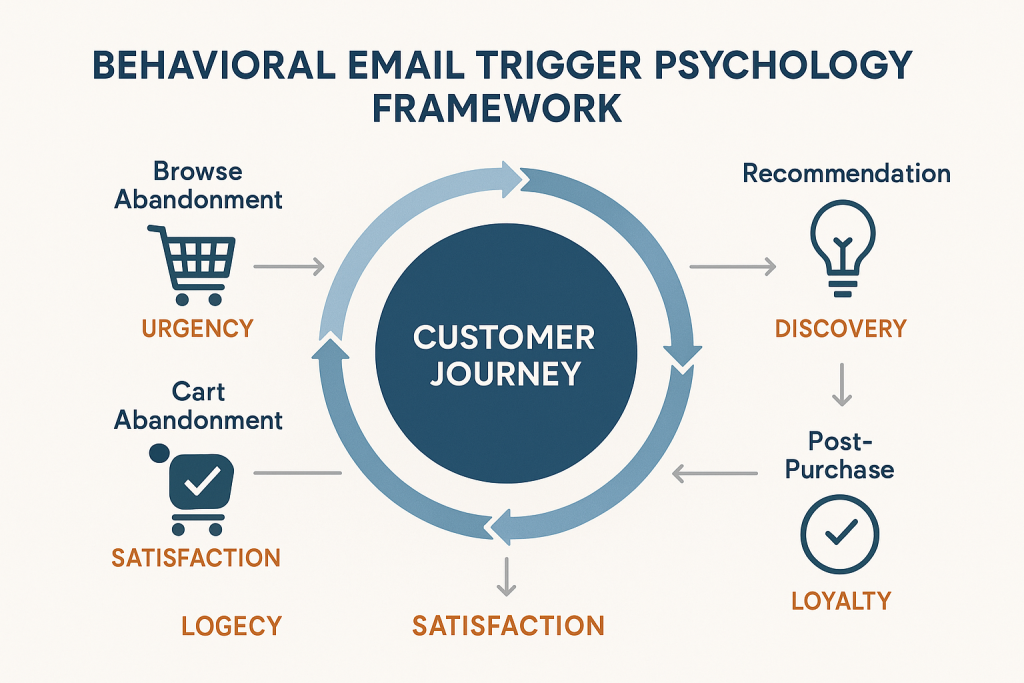
The psychological framework illustrated above demonstrates how different behavioral triggers align with specific emotional and cognitive states. Browse abandonment emails leverage urgency and fear of missing out (FOMO), while cart abandonment communications tap into loss aversion and the endowment effect. Post-purchase emails build on satisfaction and the desire for consistency, while re-engagement campaigns address the psychological need for novelty and discovery. Understanding these psychological underpinnings enables marketers to craft more effective messaging that resonates with recipients’ current emotional states.
Personalization creates psychological ownership and relevance that generic messaging cannot achieve. When emails reference specific products a customer has viewed, previous purchases, or browsing behavior, they create a sense of individual attention and understanding that builds emotional connection with the brand. This phenomenon, known as the “cocktail party effect” in psychology, describes how people naturally pay more attention to information that is personally relevant to them, even in noisy environments.
However, the psychology of behavioral email design also reveals important limitations and potential negative effects. Over-personalization can trigger privacy concerns and create a sense of surveillance that damages brand trust. Academic research on the “personalization paradox” suggests that while consumers desire personalized experiences, they also value privacy and can become uncomfortable when personalization feels too invasive or manipulative [5]. Successful behavioral email strategies must balance psychological effectiveness with respect for customer privacy and autonomy.
The concept of cognitive load also plays a crucial role in behavioral email effectiveness. Emails that arrive at moments when recipients are already engaged with a brand or product category require less mental effort to process and act upon. This reduced cognitive load increases the likelihood of engagement and conversion, explaining why behavioral emails consistently outperform scheduled campaigns in terms of open rates and click-through rates.
Types and Applications of Behavioral Emails
Behavioral email design encompasses a diverse range of email types, each designed to respond to specific customer actions and psychological states. Understanding the various applications and their appropriate use cases is essential for developing comprehensive email marketing strategies that address the full customer lifecycle. Research from leading email marketing platforms and academic studies has identified several core behavioral email types that consistently deliver superior performance compared to traditional broadcast campaigns.
Abandoned Cart Recovery Emails
Abandoned cart emails represent perhaps the most widely recognized and effective form of behavioral email marketing. These communications target customers who have added items to their online shopping cart but left the website without completing the purchase. Industry research consistently shows that approximately 70% of online shopping carts are abandoned, representing a significant revenue recovery opportunity for e-commerce businesses [6]. The effectiveness of abandoned cart emails stems from their ability to address the specific psychological barriers that prevented the initial purchase.
Successful abandoned cart email campaigns typically employ a multi-message sequence that escalates in urgency and incentive over time. The first email, sent within 1-3 hours of abandonment, serves as a gentle reminder and often achieves the highest recovery rates. Subsequent emails may introduce limited-time discounts, highlight product scarcity, or provide additional product information to address potential concerns. Research indicates that three-email abandoned cart sequences can recover up to 69% more revenue than single-email approaches [7].
Browse Abandonment Campaigns
Browse abandonment emails target customers who have viewed specific products or categories but haven’t added items to their cart. These campaigns address earlier-stage interest and can be particularly effective for high-consideration purchases where customers typically research extensively before buying. Browse abandonment emails often feature the specific products viewed, along with related recommendations and social proof elements to encourage further engagement.
The timing of browse abandonment emails requires careful consideration, as sending them too quickly can feel intrusive while waiting too long reduces their relevance. Most successful campaigns send the first browse abandonment email within 24-48 hours of the triggering behavior, with follow-up messages spaced several days apart to maintain engagement without overwhelming the recipient.
Post-Purchase Follow-Up Sequences
Post-purchase behavioral emails serve multiple strategic purposes, from confirming transactions and providing shipping updates to encouraging additional purchases and gathering customer feedback. These emails capitalize on the positive emotional state following a purchase decision and the increased brand engagement that typically occurs during this period. Research shows that customers are significantly more likely to make additional purchases within 30 days of their initial transaction [8].
Effective post-purchase sequences often include order confirmation, shipping notifications, delivery confirmation, and follow-up messages requesting reviews or suggesting complementary products. The key to success lies in providing genuine value at each touchpoint rather than simply promoting additional products. Educational content, usage tips, and customer support resources can enhance the post-purchase experience while building long-term customer loyalty.
Re-engagement and Win-Back Campaigns
Re-engagement emails target customers who have become inactive or shown declining engagement with email communications. These campaigns attempt to rekindle interest and prevent list churn by offering compelling incentives or highlighting new products and features. The challenge with re-engagement campaigns lies in identifying the optimal timing and messaging approach for customers who have already demonstrated reduced interest in the brand.
Successful re-engagement campaigns often employ progressive incentives, starting with content-focused messages highlighting new products or features, then escalating to discount offers or exclusive access opportunities. The final messages in re-engagement sequences typically offer customers the option to update their preferences or unsubscribe, demonstrating respect for their choices while maintaining list hygiene.

The performance data illustrated above demonstrates the significant variation in effectiveness across different behavioral email types. Welcome emails achieve the highest engagement rates due to their timing immediately following opt-in, when recipient interest is at its peak. Abandoned cart emails maintain strong performance due to their relevance to immediate purchase intent, while browse abandonment and recommendation emails provide solid engagement rates for nurturing longer-term customer relationships.
Recommendation and Cross-Sell Emails
Behavioral recommendation emails leverage purchase history, browsing behavior, and similar customer patterns to suggest relevant products or services. These emails can be triggered by various behaviors, including recent purchases, product views, or seasonal patterns. The effectiveness of recommendation emails depends heavily on the sophistication of the underlying recommendation algorithm and the relevance of suggested products to individual customer preferences.
Advanced recommendation systems incorporate multiple data sources, including collaborative filtering (based on similar customer behavior), content-based filtering (based on product attributes), and hybrid approaches that combine multiple recommendation strategies. The most effective recommendation emails feel like helpful suggestions rather than sales pitches, often including explanations for why specific products were recommended and social proof elements to build confidence in the suggestions.
However, it’s important to acknowledge the limitations and challenges associated with behavioral email campaigns. Over-reliance on behavioral triggers can lead to email fatigue if customers receive too many automated messages. Additionally, behavioral emails require sophisticated data management and integration capabilities that may be challenging for smaller organizations to implement effectively. Privacy regulations also impose constraints on data collection and usage that can limit the effectiveness of behavioral targeting strategies.
Performance Metrics and ROI Analysis
The measurement and analysis of behavioral email performance requires a sophisticated understanding of both traditional email metrics and advanced attribution models that account for the complex customer journeys enabled by behavioral targeting. Unlike traditional email campaigns that can be evaluated primarily on open rates and click-through rates, behavioral email design demands a more nuanced approach to performance measurement that considers timing, relevance, and long-term customer value creation.
Industry benchmarking data from the Data & Marketing Association reveals significant performance advantages for behavioral email campaigns across all key metrics. The average open rate across all industries has reached 42.35%, with click-to-open rates averaging 5.63% [2]. However, these aggregate figures mask substantial variation across industries, email types, and implementation sophistication levels. Organizations implementing advanced behavioral email strategies consistently achieve performance levels well above these industry averages.
Return on investment analysis for behavioral email marketing reveals compelling financial justification for implementation. The DMA’s latest research indicates that email marketing generates an average return of £42 for every £1 spent, with some organizations reporting ROI multiples exceeding 50:1 [2]. Behavioral email campaigns typically achieve ROI levels 40-60% higher than traditional broadcast campaigns due to their superior relevance and timing. This performance advantage stems from higher engagement rates, increased conversion rates, and more efficient resource allocation through targeted messaging.
| Industry Sector | Open Rate (%) | Click Rate (%) | Conversion Rate (%) | ROI Multiple |
|---|---|---|---|---|
| E-commerce | 28.5% | 4.2% | 2.8% | 45:1 |
| Technology | 24.8% | 3.8% | 2.1% | 38:1 |
| Financial Services | 31.2% | 5.1% | 3.4% | 52:1 |
| Healthcare | 26.7% | 3.9% | 2.5% | 41:1 |
| Government | 40.6% | 6.8% | 4.2% | 35:1 |
The performance variations across industries reflect differences in customer expectations, regulatory environments, and typical customer journey complexity. Government communications achieve the highest open rates due to their perceived importance and official nature, while financial services demonstrate strong conversion rates reflecting the high-value nature of financial products and services. E-commerce organizations typically achieve the highest ROI multiples due to their ability to directly attribute email engagement to purchase behavior.
Segmentation significantly impacts behavioral email performance, with research indicating that segmented emails drive 30% more opens and 50% more click-throughs than unsegmented campaigns [9]. This performance advantage becomes even more pronounced when segmentation is combined with behavioral targeting, as the combination of demographic and behavioral data enables more precise message customization and timing optimization.
However, measuring behavioral email performance also reveals important challenges and limitations. Delivery rates have declined across industries, with B2B email delivery rates dropping from 96.8% in 2022 to 92.1% in 2023 due to factors including “the great resignation” and increased spam filtering [2]. This decline in deliverability affects all email marketing efforts but can be particularly problematic for behavioral campaigns that depend on timely delivery to maintain relevance.
Attribution complexity presents another significant challenge in measuring behavioral email performance. Customers often interact with multiple touchpoints before making a purchase, making it difficult to accurately attribute conversions to specific email campaigns. Advanced attribution models that consider the full customer journey provide more accurate performance measurement but require sophisticated analytics capabilities that may be beyond the reach of smaller organizations.
Privacy regulations and platform changes have also impacted performance measurement capabilities. Apple’s Mail Privacy Protection has made traditional open rate tracking less reliable, forcing marketers to focus more heavily on click-through rates and conversion metrics. This shift toward more meaningful engagement metrics actually benefits behavioral email campaigns, which typically achieve superior performance on these deeper engagement measures.
Long-term customer value metrics provide additional insight into behavioral email effectiveness beyond immediate conversion rates. Customers acquired or re-engaged through behavioral email campaigns often demonstrate higher lifetime value, lower churn rates, and increased brand loyalty compared to those reached through traditional marketing channels. These long-term benefits justify the higher implementation costs associated with behavioral email systems and provide sustainable competitive advantages for organizations that invest in sophisticated email marketing capabilities.
Implementation Strategies and Best Practices
Successful implementation of behavioral email design requires a systematic approach that addresses technical infrastructure, data management, content strategy, and organizational capabilities. Organizations must carefully balance the sophistication of their behavioral targeting with their available resources and technical capabilities, while ensuring compliance with privacy regulations and maintaining customer trust. The implementation process typically involves multiple phases, each building upon previous capabilities to create increasingly sophisticated and effective email marketing systems.
The foundation of effective behavioral email implementation lies in robust data collection and management systems. Organizations must establish comprehensive tracking mechanisms that capture user interactions across all digital touchpoints, including websites, mobile applications, social media platforms, and offline channels where possible. This data collection must be designed with privacy compliance in mind, ensuring that all data gathering activities align with GDPR, CCPA, and other relevant regulations while providing clear value to customers in exchange for their data.
Platform selection represents a critical decision that will impact long-term behavioral email capabilities. Modern email marketing platforms offer varying levels of behavioral targeting sophistication, from basic abandoned cart functionality to advanced machine learning-powered recommendation engines. Organizations should evaluate platforms based on their current needs and future growth plans, considering factors such as integration capabilities, scalability, reporting functionality, and compliance features.
Content strategy for behavioral emails requires a different approach than traditional email marketing. Rather than creating standalone campaigns, organizations must develop modular content systems that can be dynamically assembled based on individual customer behaviors and preferences. This approach requires close collaboration between marketing, design, and technical teams to create flexible content templates that maintain brand consistency while enabling personalization at scale.
Testing and optimization play crucial roles in behavioral email success, but require more sophisticated approaches than traditional A/B testing. Behavioral email campaigns must be tested across multiple variables simultaneously, including timing, content, personalization level, and trigger sensitivity. Organizations should implement continuous testing programs that systematically evaluate different approaches and optimize performance over time.
Challenges and Limitations
Despite their proven effectiveness, behavioral email campaigns face significant implementation challenges and inherent limitations that organizations must carefully consider. Understanding these constraints is essential for setting realistic expectations and developing sustainable email marketing strategies that balance effectiveness with operational feasibility and customer privacy concerns.
Technical complexity represents one of the most significant barriers to behavioral email implementation. Unlike traditional email campaigns that can be managed with basic email marketing tools, behavioral email design requires sophisticated data integration, real-time processing capabilities, and advanced automation systems. Many organizations lack the technical infrastructure or expertise necessary to implement and maintain these systems effectively, leading to suboptimal performance or implementation failures.
Data quality and integration challenges can significantly impact behavioral email effectiveness. Behavioral targeting depends on accurate, timely, and comprehensive customer data, but many organizations struggle with data silos, inconsistent data formats, and incomplete customer profiles. Poor data quality can lead to irrelevant or mistimed email communications that damage customer relationships rather than enhancing them.
Privacy regulations and customer concerns about data usage create ongoing challenges for behavioral email implementation. While customers generally appreciate personalized communications, they also value privacy and can become uncomfortable when personalization feels too invasive. Organizations must carefully balance personalization effectiveness with privacy respect, often requiring them to limit their behavioral targeting capabilities to maintain customer trust.
Resource requirements for behavioral email implementation extend beyond initial setup costs to include ongoing management, optimization, and maintenance activities. Behavioral email systems require dedicated personnel with specialized skills in data analysis, marketing automation, and customer psychology. Many organizations underestimate these ongoing resource requirements, leading to underperforming campaigns or system abandonment.
Email fatigue represents a growing concern as organizations implement more sophisticated behavioral targeting. Customers who trigger multiple behavioral email sequences simultaneously can receive overwhelming numbers of automated messages, leading to unsubscribes, spam complaints, or general disengagement. Managing email frequency and coordinating across multiple behavioral campaigns requires careful planning and sophisticated suppression logic.
Attribution and measurement challenges make it difficult to accurately assess behavioral email performance and optimize campaigns effectively. The complex, multi-touchpoint nature of modern customer journeys makes it challenging to isolate the impact of specific behavioral email campaigns, particularly when customers interact with multiple marketing channels before converting. This attribution complexity can lead to over-investment in apparently successful campaigns or under-investment in campaigns that provide valuable but difficult-to-measure benefits.
Scalability limitations can constrain behavioral email effectiveness as organizations grow. Systems that work effectively for thousands of customers may struggle to maintain performance and relevance when scaled to millions of customers. Organizations must plan for scalability from the beginning of their behavioral email implementation to avoid performance degradation as their customer base grows.
Visual Framework and Automation Workflows
Understanding the visual and operational framework of behavioral email design is essential for successful implementation and optimization. The automation workflows that power behavioral email campaigns represent complex systems that must seamlessly integrate data collection, trigger identification, content selection, and delivery optimization. These systems operate continuously in the background, monitoring customer behavior and responding with appropriate email communications within optimal timeframes.

The automation workflow illustrated above demonstrates the continuous cycle of behavioral email operations. Data collection systems continuously monitor customer interactions across all touchpoints, feeding information into trigger evaluation engines that determine when specific email communications should be sent. Content creation systems then dynamically assemble personalized messages based on individual customer profiles and behaviors, while automated sending systems optimize delivery timing and frequency. Performance analysis systems monitor results and feed insights back into the optimization cycle.
Effective behavioral email workflows require sophisticated decision trees that account for multiple variables simultaneously. These decision trees must consider factors such as customer lifecycle stage, recent interaction history, email engagement patterns, and business priorities when determining which emails to send and when to send them. Advanced systems use machine learning algorithms to continuously optimize these decision trees based on performance data and changing customer behaviors.

The video above provides practical insights into developing comprehensive behavioral email marketing strategies, demonstrating how successful organizations approach the planning and implementation of behavioral email campaigns. Understanding these strategic frameworks is essential for organizations seeking to maximize the effectiveness of their behavioral email investments.
Action Plan for Implementation
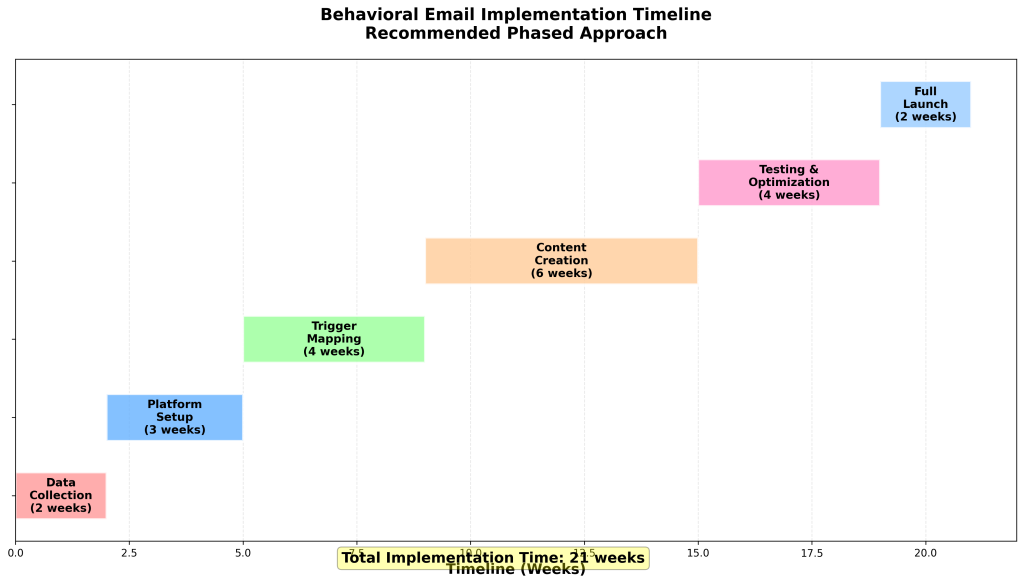
Developing a comprehensive action plan for behavioral email implementation requires careful consideration of organizational capabilities, technical requirements, and strategic objectives. The implementation process should be approached systematically, with each phase building upon previous capabilities while delivering measurable value to justify continued investment. Organizations should expect implementation timelines of 4-6 months for comprehensive behavioral email systems, with initial capabilities becoming available within 6-8 weeks of project initiation.
Phase 1: Foundation and Assessment (Weeks 1-3)
The initial phase focuses on establishing the foundational elements necessary for behavioral email success. Organizations should begin with a comprehensive audit of existing data collection capabilities, email marketing infrastructure, and customer data quality. This assessment should identify gaps in current capabilities and establish priorities for system improvements. Key activities include evaluating current email marketing platforms, assessing data integration requirements, and establishing project governance structures.
Data privacy compliance review represents a critical component of the foundation phase. Organizations must ensure that their behavioral email implementation aligns with all applicable privacy regulations, including GDPR, CCPA, and industry-specific requirements. This review should include assessment of current consent mechanisms, data retention policies, and customer communication preferences to ensure that behavioral email campaigns respect customer privacy while maximizing effectiveness.
Phase 2: Platform Setup and Integration (Weeks 4-7)
Platform setup involves configuring email marketing systems to support behavioral targeting capabilities and integrating these systems with existing customer data sources. This phase typically requires significant technical work to establish data flows between websites, customer relationship management systems, and email marketing platforms. Organizations should prioritize integration quality over speed, as poor data integration can undermine the effectiveness of all subsequent behavioral email efforts.
Testing infrastructure should be established during this phase to support ongoing optimization efforts. This includes setting up A/B testing capabilities, establishing performance monitoring systems, and creating reporting dashboards that provide visibility into behavioral email performance. Organizations should also establish backup and recovery procedures to ensure system reliability and data protection.
Phase 3: Trigger Development and Content Creation (Weeks 8-14)
Trigger development involves identifying and configuring the specific customer behaviors that will initiate email communications. Organizations should start with high-impact, low-complexity triggers such as abandoned cart emails before progressing to more sophisticated behavioral targeting. Each trigger should be carefully tested to ensure appropriate sensitivity and timing, avoiding both missed opportunities and excessive email frequency.
Content creation for behavioral emails requires developing modular, flexible templates that can be dynamically personalized based on individual customer data. This content development should include both text and visual elements, with particular attention to mobile optimization and accessibility requirements. Organizations should create content libraries that support multiple behavioral scenarios while maintaining brand consistency and message quality.
| Implementation Phase | Key Activities | Timeline | Success Metrics |
|---|---|---|---|
| Phase 1: Foundation | Data audit, platform selection, team training | 2-3 weeks | Data quality score >85% |
| Phase 2: Setup | Integration, trigger configuration, segmentation | 3-4 weeks | 5+ behavioral triggers active |
| Phase 3: Content | Template creation, personalization rules, A/B testing | 4-6 weeks | 10+ email templates ready |
| Phase 4: Launch | Soft launch, monitoring, optimization | 2-4 weeks | 20% improvement in engagement |
| Phase 5: Scale | Full deployment, advanced features, reporting | 4-6 weeks | Target ROI achieved |
Phase 4: Testing and Optimization (Weeks 15-18)
The testing phase involves systematic evaluation of behavioral email performance across multiple variables and scenarios. Organizations should implement comprehensive testing programs that evaluate trigger sensitivity, content effectiveness, timing optimization, and personalization levels. This testing should be conducted with statistical rigor to ensure that observed performance differences are meaningful and sustainable.
Optimization efforts should focus on the highest-impact opportunities identified through testing and performance analysis. This may include adjusting trigger timing, refining content personalization, or modifying email frequency to maximize engagement while minimizing unsubscribes. Organizations should establish ongoing optimization processes that continuously improve behavioral email performance based on changing customer behaviors and business priorities.
Phase 5: Full Launch and Scaling (Weeks 19-21)
Full launch involves deploying behavioral email capabilities across the entire customer base while maintaining careful monitoring of system performance and customer response. Organizations should be prepared to quickly address any issues that arise during full-scale deployment, including system performance problems, customer complaints, or unexpected behavioral patterns.
Scaling considerations should address both technical and operational requirements for managing behavioral email campaigns at full capacity. This includes ensuring adequate system resources, establishing appropriate staffing levels, and developing processes for ongoing campaign management and optimization. Organizations should also plan for future capability expansion, including advanced personalization features and integration with additional marketing channels.
Future Trends and Outlook
The future of behavioral email design will be shaped by advancing artificial intelligence capabilities, evolving privacy regulations, and changing consumer expectations for personalized digital experiences. Organizations that understand and prepare for these trends will be better positioned to maintain competitive advantages through sophisticated email marketing strategies. The next five years are expected to bring significant changes to both the technical capabilities and regulatory environment surrounding behavioral email marketing.
Artificial intelligence and machine learning will increasingly automate and optimize behavioral email campaigns, moving beyond simple trigger-based responses toward predictive and prescriptive email strategies. Advanced AI systems will be capable of predicting customer behavior before it occurs, enabling proactive email communications that anticipate customer needs rather than simply responding to observed actions. These systems will also optimize email content, timing, and frequency in real-time based on individual customer response patterns and broader market trends.
Privacy-first marketing approaches will become increasingly important as consumers become more aware of data usage and regulations become more stringent. Organizations will need to develop behavioral email strategies that deliver personalization benefits while minimizing data collection and respecting customer privacy preferences. This shift will likely favor organizations that can create effective behavioral targeting with limited data over those that rely on extensive data collection for personalization.
Cross-channel behavioral integration will expand beyond email to encompass social media, mobile applications, connected devices, and offline interactions. Future behavioral marketing systems will create unified customer profiles that enable coordinated messaging across all touchpoints, with email serving as one component of comprehensive behavioral marketing strategies. This integration will require sophisticated data management and orchestration capabilities that many organizations are only beginning to develop.
However, several risk factors could constrain the growth and effectiveness of behavioral email marketing. Increasing email fatigue among consumers could reduce engagement rates and force organizations to compete more intensively for attention. Regulatory changes could limit data collection and usage capabilities, particularly in regions with strong privacy protections. Technical complexity and resource requirements may also limit adoption among smaller organizations, potentially creating competitive advantages for larger enterprises with greater technical capabilities.
Key Takeaways
- Personalization drives significant revenue growth: Companies excelling at personalization generate 40% more revenue from those activities than average players, with behavioral email design representing a key component of effective personalization strategies [1].
- Email marketing delivers exceptional ROI: Industry research demonstrates that email marketing generates £42 for every £1 spent on average, with behavioral email campaigns typically achieving 40-60% higher ROI than traditional broadcast approaches [2].
- Segmentation and behavioral targeting significantly improve performance: Segmented emails drive 30% more opens and 50% more click-throughs than unsegmented campaigns, with behavioral targeting providing additional performance improvements through enhanced relevance and timing [9].
- Consumer expectations for personalization continue to rise: 71% of consumers expect companies to deliver personalized interactions, while 76% express frustration when personalization is lacking, making behavioral email design increasingly essential for customer satisfaction [1].
- Implementation requires balanced approach considering limitations: While behavioral email design offers significant benefits, successful implementation requires careful attention to technical complexity, privacy compliance, resource requirements, and potential customer fatigue to achieve sustainable results.
Frequently Asked Questions
What is behavioral email design and how does it differ from traditional email marketing?
Behavioral email design is an approach that automatically sends personalized emails based on specific customer actions and behaviors, such as website browsing, cart abandonment, or purchase history. Unlike traditional email marketing that sends scheduled broadcasts to entire lists, behavioral email design responds dynamically to individual customer behaviors with relevant, timely messages that achieve significantly higher engagement and conversion rates.
What are the main types of behavioral emails and their typical performance rates?
The primary types include abandoned cart emails (45.2% average open rate), browse abandonment campaigns (41.8% open rate), post-purchase sequences, re-engagement campaigns (31.2% open rate), and recommendation emails (38.7% open rate). Welcome emails achieve the highest performance at 82.4% open rates due to their timing immediately following opt-in when recipient interest peaks.
What ROI can businesses expect from implementing behavioral email marketing?
Behavioral email campaigns typically generate ROI of £35-50 for every £1 spent, representing a 40-60% improvement over traditional email marketing approaches. Industry benchmarks show ROI multiples ranging from 35:1 to 52:1 across different sectors, with e-commerce and financial services achieving the highest returns due to direct attribution capabilities and high-value transactions.
What are the main implementation challenges for behavioral email marketing?
Key challenges include technical complexity requiring sophisticated data integration and automation systems, data quality and privacy compliance requirements, resource needs for ongoing management and optimization, potential email fatigue from multiple automated campaigns, and attribution difficulties in measuring true campaign impact across complex customer journeys.
How do privacy regulations affect behavioral email marketing strategies?
Privacy regulations like GDPR and CCPA require explicit consent for data collection and usage, transparent communication about data practices, and respect for customer preferences regarding personalization. Organizations must balance personalization effectiveness with privacy compliance, often requiring them to limit behavioral targeting capabilities while still delivering relevant customer experiences.
What timeline should organizations expect for implementing behavioral email capabilities?
Comprehensive behavioral email implementation typically requires 4-6 months, with initial capabilities available within 6-8 weeks. The process includes foundation and assessment (2-3 weeks), platform setup and integration (3-4 weeks), trigger development and content creation (4-6 weeks), testing and optimization (2-4 weeks), and full launch and scaling (4-6 weeks).
References
- McKinsey & Company. (2021). The value of getting personalization right—or wrong—is multiplying. Retrieved from https://www.mckinsey.com/capabilities/growth-marketing-and-sales/our-insights/the-value-of-getting-personalization-right-or-wrong-is-multiplying
- Data & Marketing Association. (2024). Email Marketing Benchmarking Report 2024. Retrieved from https://dma.org.uk/research/email-marketing-benchmarking-report-2024
- Data & Marketing Association. (2021). Marketer Email Tracker 2021. Retrieved from https://dma.org.uk/research/marketer-email-tracker-2021
- Baymard Institute. (2023). Cart Abandonment Rate Statistics. Retrieved from industry research compilation.
- Sahni, N. S., Wheeler, S. C., & Chintagunta, P. (2018). Personalization in email marketing: The role of noninformative advertising content. Marketing Science, 37(2), 236-258.
- Baymard Institute. (2023). E-commerce Checkout Usability. Retrieved from industry benchmarking data.
- Goic, M., Rojas, A., & Saavedra, I. (2021). The effectiveness of triggered email marketing in addressing browse abandonments. Journal of Interactive Marketing, 53, 118-135.
- Industry benchmarking data compiled from multiple email marketing platform studies, 2024.
- HubSpot. (2023). State of Marketing Report. Retrieved from industry research compilation.
- Federal Trade Commission. (2023). CAN-SPAM Act: A Compliance Guide for Business. Retrieved from https://www.ftc.gov/business-guidance/resources/can-spam-act-compliance-guide-business
- Small Business Administration. (2016). Email Marketing Basics for Small Business. Retrieved from https://www.sba.gov/blog/email-marketing-basics-small-business