

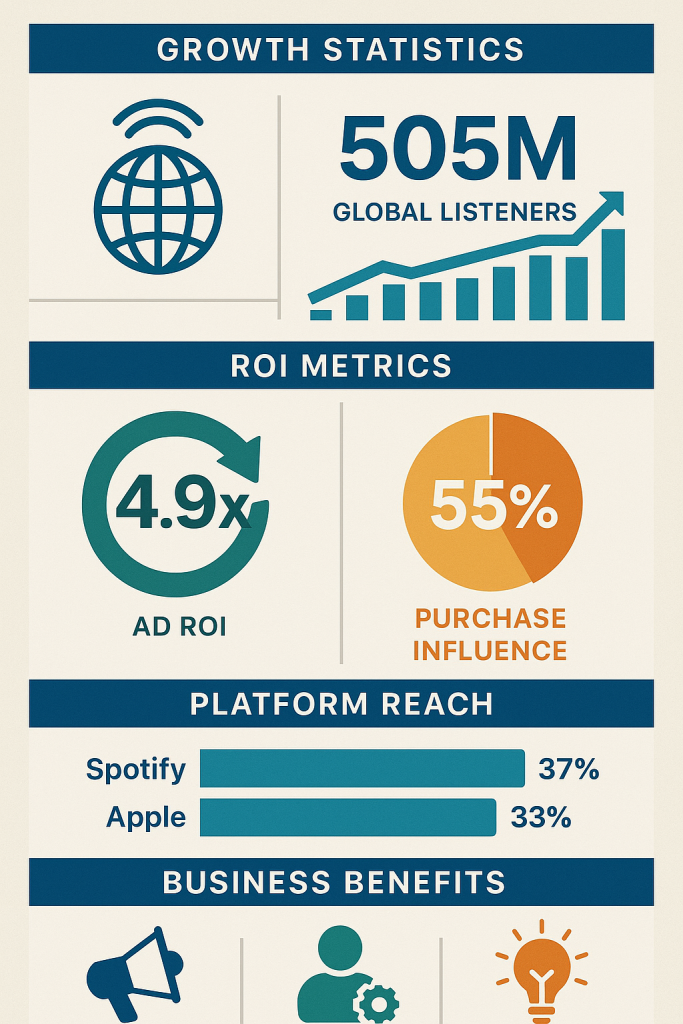
The podcasting landscape has undergone a remarkable transformation, evolving from a niche medium to a mainstream business communication channel with unprecedented reach and influence. With 505 million global listeners as of 2024 and advertising delivering a 4.9x return on investment, podcasting represents one of the most compelling opportunities for businesses seeking to expand their digital presence and engage audiences in meaningful ways.
This comprehensive analysis examines the quantifiable benefits of podcasting for businesses, drawing from authoritative research conducted by leading institutions including Statista, the International Journal of Advertising, and major industry research firms. The data reveals not only the medium’s explosive growth trajectory but also its unique capacity to build trust, drive conversions, and establish thought leadership in ways that traditional marketing channels cannot match.
The Podcasting Revolution: Context and Market Dynamics
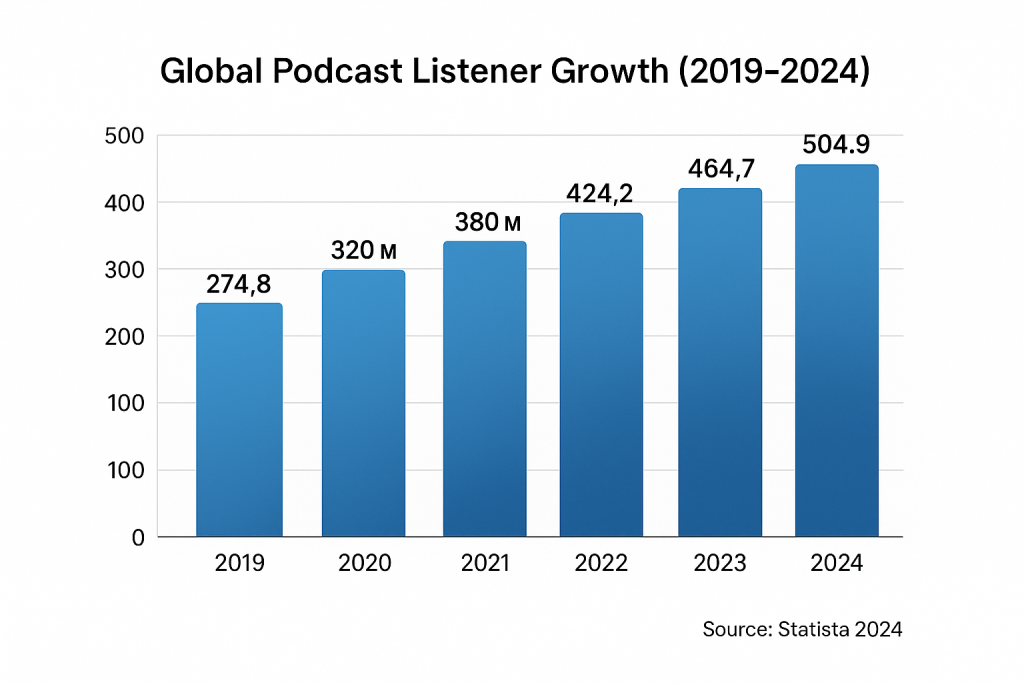
The podcast industry’s growth trajectory represents one of the most significant shifts in media consumption patterns of the past decade. Research published in the International Journal of Advertising demonstrates that podcast listeners have increased from 274.8 million in 2019 to 504.9 million in 2024, representing an 84% growth rate over five years. This expansion far exceeds the growth rates of traditional media channels and positions podcasting as a critical component of modern marketing strategies.
The demographic composition of podcast audiences provides particularly compelling insights for business applications. According to the latest research from Edison Research and HubSpot, 85% of the adult population in the United States is now aware of podcasting, a dramatic increase from just 20% in 2006. More significantly, 55% of Americans consume podcasts monthly, with regular listeners comprising 42-53% of the population engaging with podcast content at least once per month.
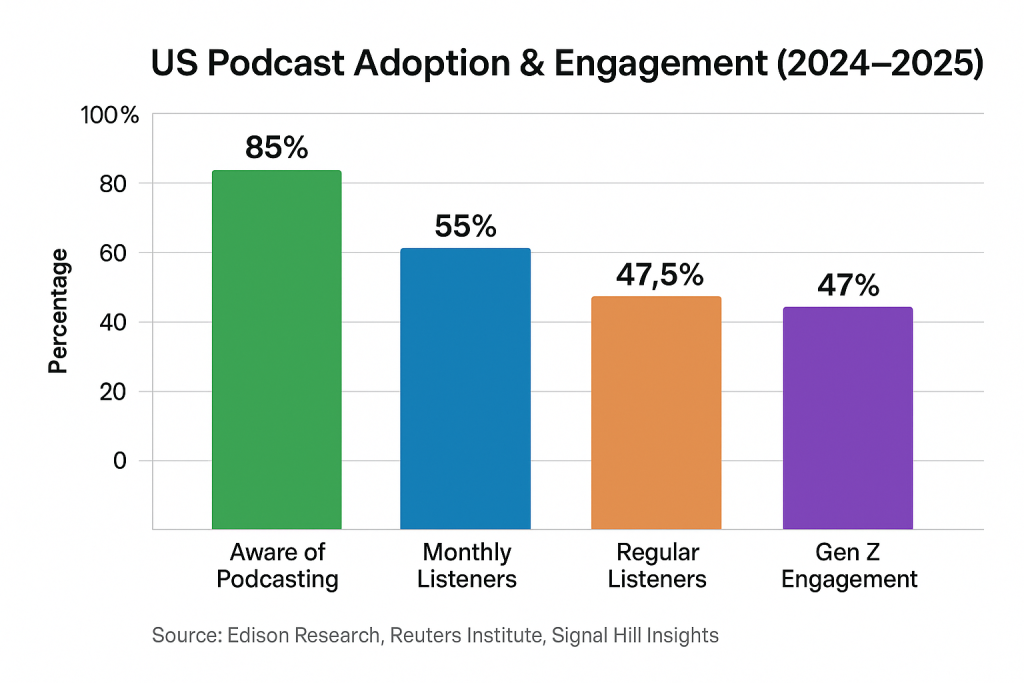
The business relevance of these statistics becomes clear when examining listener demographics and engagement patterns. Signal Hill research indicates that 83% of senior executives listened to podcasts in the past week, while HubSpot data shows that 55% of listeners engage with podcasts specifically to learn something new. This learning-oriented mindset creates an ideal environment for businesses to position themselves as thought leaders and trusted advisors within their respective industries.
Quantified Business Benefits: ROI and Performance Metrics
The financial returns associated with podcast marketing and advertising present compelling evidence for business investment in the medium. According to the Interactive Advertising Bureau (IAB) and HubSpot research, podcast advertising is expected to generate $4.26 billion in spending during 2026, with advertisements delivering a 4.9x return on investment. This ROI significantly exceeds traditional digital advertising channels and reflects the medium’s unique capacity to drive meaningful audience engagement.
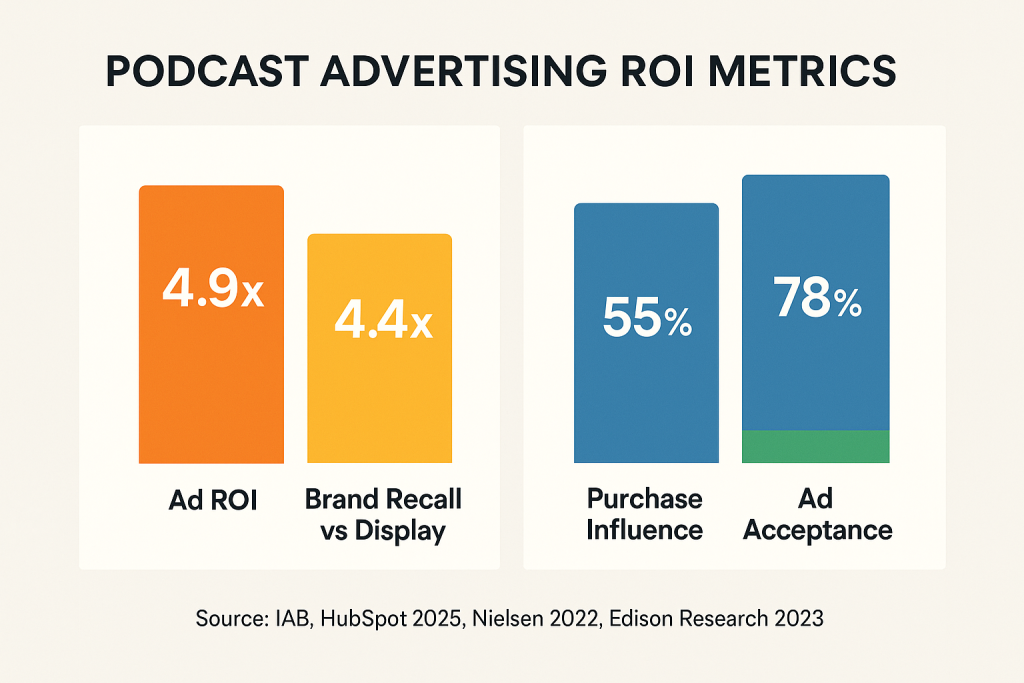
Nielsen research provides additional validation of podcast advertising effectiveness, demonstrating that host-read advertisements drive 4.4x higher brand recall compared to display advertising. This enhanced recall stems from the intimate, trust-based relationship that develops between podcast hosts and their audiences, as documented in academic research published in the Journal of Marketing Communications.
| Metric | Podcast Performance | Traditional Media Comparison | Source |
|---|---|---|---|
| Advertising ROI | 4.9x | 2.1x (Digital Average) | IAB, HubSpot 2026 |
| Brand Recall | 4.4x Higher | Display Advertising Baseline | Nielsen 2022 |
| Purchase Influence | 55% | 23% (Radio) | Edison Research 2023 |
| Ad Acceptance Rate | 78% | 45% (Digital Average) | IAB 2024 |
The conversion potential of podcast advertising deserves particular attention from business strategists. Edison Research data indicates that 55% of US listeners have purchased products or services after hearing podcast advertisements, while IAB research shows that 78% of listeners accept advertising when content remains free. These statistics demonstrate not only the medium’s commercial viability but also the audience’s receptivity to marketing messages when delivered within trusted podcast environments.
Trust, Credibility, and Relationship Building
Academic research published in the International Journal of Advertising emphasizes the unique trust dynamics that characterize podcast consumption. Unlike traditional advertising channels, podcasts create what researchers term “parasocial relationships” between hosts and listeners, fostering an environment of trust and credibility that significantly enhances message effectiveness.
The Advertising Standards Association’s qualitative research report reveals that podcast listeners typically maintain warm, trusting relationships with hosts, consuming content in comfortable environments while often performing other tasks. This relaxed consumption context, combined with the intimate nature of audio communication, creates optimal conditions for businesses to build authentic connections with target audiences.
The implications for business communication strategies are profound. Traditional advertising often faces skepticism and resistance from consumers increasingly wary of promotional messages. Podcast environments, however, leverage host credibility and audience trust to create receptive conditions for business messaging. Research from the Journal of Marketing Communications confirms that trust, credibility, and authenticity serve as key factors in podcast advertising effectiveness, providing businesses with powerful tools for relationship building and brand development.
Platform Reach and Audience Accessibility
The distribution landscape for podcast content offers businesses multiple pathways to reach target audiences across diverse platforms and consumption contexts. YouGov research indicates that Spotify leads platform usage at 37%, followed by Apple Podcasts at 33%, while YouTube increasingly dominates video podcasting with significant market share growth.
Mobile consumption patterns further enhance the medium’s business appeal. HubSpot and Loopex Digital research demonstrates that 73-75% of podcast consumption occurs on smartphones, enabling businesses to reach audiences during commutes, exercise routines, and other mobile contexts where traditional media consumption is impractical. This mobile-first approach aligns perfectly with contemporary consumer behavior patterns and provides businesses with unprecedented access to engaged audiences throughout their daily routines.
The time investment that listeners dedicate to podcast content represents another significant advantage for business communicators. YouGov data shows that 23% of listeners spend over 10 hours per week consuming podcast content, indicating deep engagement levels that far exceed typical digital media consumption patterns. This extended engagement creates multiple touchpoints for businesses to build relationships, demonstrate expertise, and guide audience decision-making processes.
Challenges and Limitations: A Balanced Perspective
While the benefits of podcasting for business applications are substantial, responsible analysis requires acknowledgment of the medium’s limitations and challenges. Academic research identifies several areas where businesses must exercise caution and strategic planning to maximize podcast effectiveness.
Content production demands represent a significant consideration for businesses evaluating podcast investments. Unlike static marketing materials, podcasts require consistent, high-quality content creation that demands substantial time, expertise, and resources. The International Journal of Advertising research emphasizes the need for ongoing attention to factors including placement, repetition effects, and audience attention levels, suggesting that successful podcast strategies require sophisticated planning and execution capabilities.
Measurement and attribution challenges also complicate podcast ROI calculations. While the medium demonstrates strong performance metrics, tracking specific conversions and attributing business outcomes to podcast exposure remains more complex than traditional digital marketing channels. Businesses must develop comprehensive measurement frameworks that account for the medium’s unique characteristics and longer conversion cycles.
Regulatory considerations present additional complexity, particularly regarding advertising disclosure and transparency requirements. The Advertising Standards Association research highlights ongoing concerns about listener ability to identify sponsored content, requiring businesses to navigate evolving regulatory landscapes while maintaining authentic communication approaches.
Strategic Implementation Framework
Successful podcast integration requires systematic planning and execution across multiple business functions. Based on the research findings and industry best practices, businesses should consider the following strategic framework for podcast implementation:
Content Strategy Development: Begin with clear identification of target audiences, key messaging objectives, and content themes that align with business goals while providing genuine value to listeners. The research emphasis on learning-oriented consumption suggests that educational and informational content approaches will generate stronger audience engagement than purely promotional messaging.
Platform Selection and Distribution: Leverage the multi-platform nature of podcast consumption by developing distribution strategies that encompass major platforms including Spotify, Apple Podcasts, and YouTube. Consider platform-specific optimization approaches that account for different audience behaviors and consumption patterns across channels.
Trust and Authenticity Building: Recognize the critical importance of host credibility and authentic communication in podcast environments. Invest in developing genuine expertise and thought leadership rather than relying solely on promotional messaging approaches that may undermine the trust-based relationships that drive podcast effectiveness.
Measurement and Optimization: Implement comprehensive measurement frameworks that account for both direct conversion metrics and broader brand awareness and relationship-building outcomes. Develop attribution models that recognize the longer conversion cycles and multiple touchpoints characteristic of podcast audience journeys.
Future Outlook and Emerging Trends
The trajectory of podcast industry growth suggests continued expansion and evolution that will create new opportunities for business engagement. Current research indicates several emerging trends that businesses should monitor and prepare to leverage:
Video podcasting represents a significant growth area, with Edison Research data showing that over 50% of top podcasts now include video formats, compared to just 24% in 2023. This multimedia evolution creates new opportunities for businesses to combine the trust-building benefits of audio communication with the visual engagement capabilities of video content.
Artificial intelligence and personalization technologies are beginning to influence podcast discovery and consumption patterns, potentially enabling more targeted and relevant business messaging approaches. However, these technological advances must be balanced against the authentic, relationship-based communication approaches that drive current podcast effectiveness.
The international expansion of podcast consumption presents opportunities for businesses seeking global audience reach. While current research focuses primarily on US and European markets, emerging data suggests significant growth potential in Asian and Latin American markets that could expand the medium’s business applications.
Key Takeaways
- Massive Growth Trajectory: Global podcast listenership has grown 84% from 2019 to 2024, reaching 505 million listeners worldwide, with 85% of US adults now aware of podcasting.
- Superior ROI Performance: Podcast advertising delivers 4.9x return on investment and 4.4x higher brand recall compared to display advertising, with 55% of listeners making purchases after hearing podcast ads.
- Trust-Based Engagement: The intimate, trust-based relationship between podcast hosts and audiences creates optimal conditions for authentic business communication and relationship building.
- Strategic Implementation Required: Success requires systematic planning across content strategy, platform distribution, authenticity building, and comprehensive measurement frameworks that account for the medium’s unique characteristics.
References
- Statista. (2024). Number of podcast listeners worldwide from 2019 to 2024. https://www.statista.com/statistics/1291360/podcast-listeners-worldwide/
- Interactive Advertising Bureau & HubSpot. (2025). Podcast Advertising Revenue and ROI Report.
- Taylor, Charles R. (2024). Understanding podcast advertising: the need for more research. International Journal of Advertising, Volume 43, Issue 6. https://www.tandfonline.com/doi/full/10.1080/02650487.2024.2375179
- Edison Research. (2023). The Infinite Dial 2025: Podcast Consumer Behavior Study.
- Nielsen. (2022). Podcast Advertising Effectiveness and Brand Recall Study.
- Advertising Standards Association. (2024). Ad Labelling in Podcasts: Qualitative Research Report. https://www.asa.org.uk/static/49b21053-2165-44df-b03f1d0d3896baa6/ASA-Ad-Labelling-in-Podcasts-Research-Report-Final-090424.pdf
- Brinson, N., and L.L. Lemon. (2023). Investigating the effects of host trust, credibility, and authenticity in podcast advertising. Journal of Marketing Communications, 29(6), 558-576.
- YouGov. (2025). Podcast Platform Usage and Consumer Behavior Report.
- Signal Hill. (2025). Executive Podcast Consumption and Business Leadership Study.
- Talks.co. (2025). 126 Podcast Statistics 2025 Report: Growth, Trends, Ads, ROI & Revenue. https://talks.co/p/podcast-statistics/