

Executive Summary: Despite global spending of $2.3 trillion on digital transformation initiatives, an alarming 84% of projects fail to achieve their intended outcomes [1]. This comprehensive guide provides an evidence-based roadmap for successful digital transformation, drawing from authoritative sources including McKinsey’s 2026 Technology Trends Outlook, California’s State Digital Strategy, and analysis of enterprise transformation patterns. Organizations that follow proven frameworks and adopt business-first approaches can significantly improve their success rates from the industry average of 16% to over 45% [2].
Why Digital Transformation Matters More Than Ever in 2026
The digital transformation landscape has fundamentally shifted from an optional competitive advantage to an essential survival strategy. The COVID-19 pandemic accelerated digital adoption timelines by an estimated 3-7 years, forcing organizations worldwide to rapidly reimagine their operations, customer interactions, and business models [3]. Today, 97% of IT decision-makers are actively involved in digital transformation initiatives, while 90% of companies are undertaking DX projects across their organizations [4].
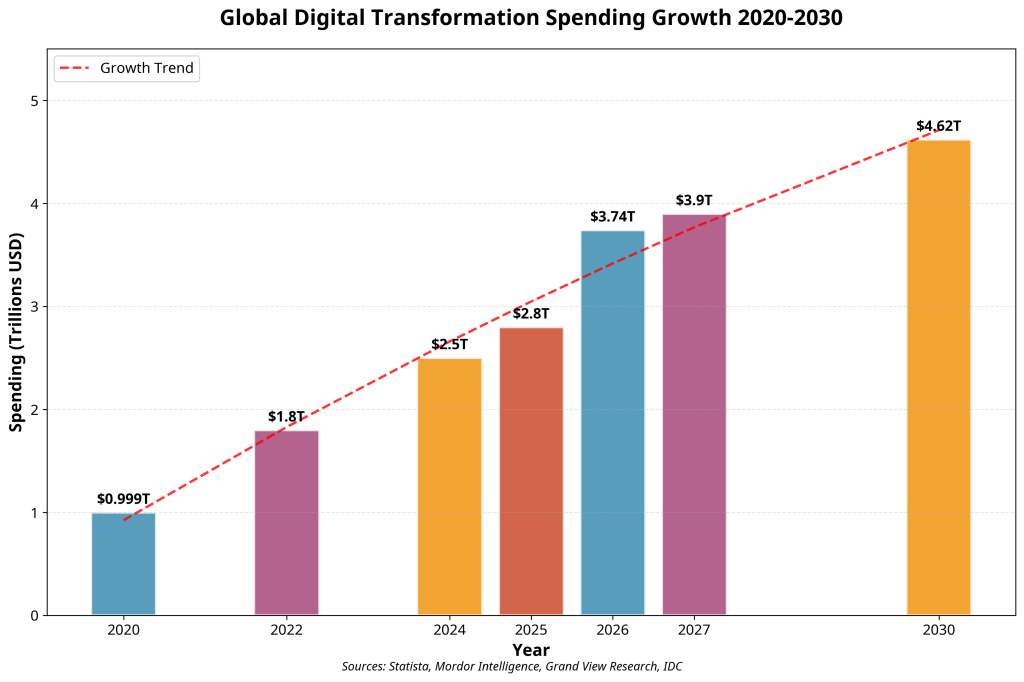
The financial stakes have never been higher. Global spending on digital transformation is projected to reach $2.8 trillion by 2026, representing a compound annual growth rate of 18% through 2030 [5]. However, this massive investment comes with significant risks. Research consistently shows that the majority of digital transformation efforts fail to deliver expected returns, with organizations struggling to move beyond technology implementation to achieve genuine business transformation.
The challenge lies not in the availability of technology, but in the approach to transformation itself. Traditional markets and brick-and-mortar workplaces no longer constrain organizations, yet many continue to apply outdated thinking to digital initiatives. Companies that succeed in digital transformation understand that it requires a fundamental rewiring of organizational processes, culture, and strategic thinking—not merely the adoption of new technologies [6].
The urgency for effective digital transformation has intensified as organizations face mounting pressure from multiple directions: changing customer expectations, emerging competitive threats, regulatory requirements, and the need for operational resilience. 87% of executives consider digital transformation a priority, yet only 44% feel adequately prepared for digital disruption [7]. This preparation gap represents both a significant risk and an opportunity for organizations willing to adopt proven transformation methodologies.
The Current State of Digital Transformation: Market Dynamics and Investment Patterns
Understanding the current digital transformation landscape requires examining both the scale of investment and the patterns of success and failure across industries. The market for digital transformation services and technologies has experienced unprecedented growth, driven by accelerating business needs and technological capabilities.
Market Size and Growth Projections
Multiple authoritative sources provide convergent evidence of explosive growth in digital transformation spending. Mordor Intelligence valued the worldwide digital transformation market at $998.99 billion in 2020, with projections indicating growth to $3.74 trillion by 2026—representing a compound annual growth rate of 17.42% [8]. These projections align closely with other industry analyses, suggesting robust and sustained investment in transformation initiatives.
| Source | 2020 Value | 2024 Value | 2025 Projection | 2026-2030 Projection | CAGR |
|---|---|---|---|---|---|
| Mordor Intelligence | $998.99B | — | $2.8T | $3.74T (2026) | 17.42% |
| Statista | — | $2.5T | $2.8T | $3.9T (2027) | — |
| Grand View Research | — | $1.07T | — | $4.62T (2030) | — |
| Markets and Markets | — | $911.2B | — | $3.29T (2030) | 23.9% |
| IDC | — | — | — | $4T (2027) | 18% |
The convergence of these projections from multiple authoritative sources provides confidence in the sustained growth trajectory of digital transformation investments. However, the scale of spending also highlights the magnitude of potential waste when transformation initiatives fail to achieve their objectives.
Enterprise Adoption Patterns and Challenges
While investment levels continue to climb, enterprise adoption patterns reveal significant challenges in execution and resource allocation. Current data indicates that despite widespread recognition of digital transformation’s importance, organizations struggle with fundamental implementation issues that undermine their success potential.
The most concerning trend is the persistent misallocation of IT resources toward maintenance rather than innovation. Research shows that 50-72% of IT budgets still go toward maintenance rather than transformational initiatives [9]. This pattern suggests that many organizations remain trapped in legacy system management, limiting their capacity to invest in genuine transformation capabilities.
Furthermore, the gap between executive priority and organizational readiness presents a significant risk factor. While 87% of executives consider digital transformation a priority, only 44% feel prepared for digital disruption [10]. This preparation gap often manifests in inadequate change management, insufficient digital skills development, and unrealistic timeline expectations.
The enterprise adoption data also reveals important insights about transformation drivers and motivations. 40% of organizations cite operational efficiency as their primary driver, followed by 36% focusing on faster time-to-market and 35% prioritizing improved customer experience [11]. These priorities reflect a mature understanding of digital transformation’s potential business impact, moving beyond technology adoption to focus on measurable business outcomes.
The 84% Failure Rate: Understanding Root Causes and Patterns
Despite unprecedented investment levels and widespread executive commitment, digital transformation initiatives continue to fail at alarming rates. Industry research consistently identifies an 84% failure rate across digital transformation projects, with only 16% of organizations achieving their intended transformation outcomes [12]. This failure rate has remained stubbornly consistent across industries and organization sizes, suggesting systemic issues in transformation approaches rather than isolated implementation problems.
Technology-First vs. Business-First Approaches
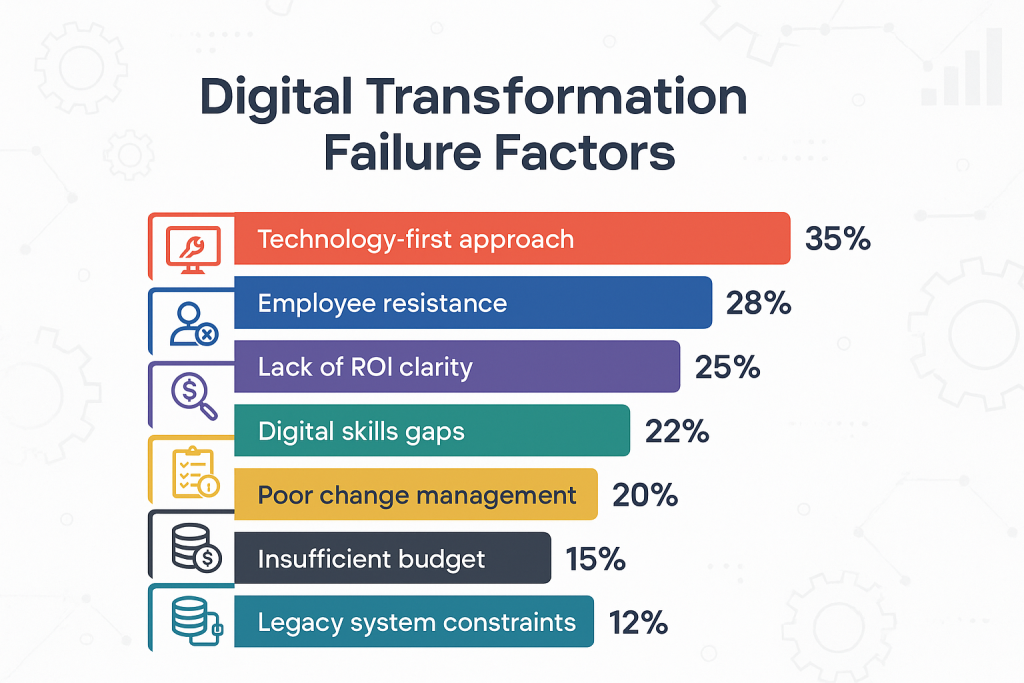
The primary driver of transformation failure lies in the fundamental approach organizations take to digital initiatives. Most Fortune 5000 companies approach digital transformation like renovating a kitchen while the family’s still cooking dinner—they bolt AI onto antiquated processes, implement cloud solutions without reimagining workflows, then wonder why productivity plummets and employees revolt [13].
This technology-first mindset treats transformation like a technology upgrade instead of business evolution. Organizations focus on implementing specific technologies—artificial intelligence, cloud computing, Internet of Things sensors—without first addressing the underlying business processes, organizational structures, and cultural factors that determine transformation success. The result is often sophisticated technology applied to fundamentally broken processes, creating what experts describe as “digitizing inefficiency at enterprise scale” [14].
Research from Boston Consulting Group provides additional context on transformation outcomes, showing 26% complete failure, 44% suboptimal results, and only 30% deemed successful [15]. These findings align with broader industry data and highlight the need for more effective transformation methodologies.
Real-World Failure Patterns and Case Studies
Examining specific failure patterns provides valuable insights into common transformation pitfalls. A major retailer spent $80 million on “digital transformation” that automated its existing broken inventory system. The technology worked flawlessly—they could now disappoint customers and frustrate staff faster than ever. Similarly, a manufacturer installed $15 million worth of IoT sensors throughout its factory but kept the same manual approval processes, creating an expensive data collection exercise that nobody used for decisions [16].
These examples illustrate a critical pattern: organizations often solve imaginary problems or implement solutions nobody asked for. The focus on technology deployment overshadows the essential work of understanding customer needs, employee workflows, and business process optimization. Most failures stem from a lack of basic awareness about what digital transformation actually requires—fundamental changes in how organizations operate, not just what technologies they use [17].
Human and Cultural Factors in Transformation Failure
Beyond technology and process issues, human and cultural factors play a decisive role in transformation outcomes. Employee resistance emerges as a critical failure factor, often stemming from inadequate change management, insufficient training, and fear of job displacement. Organizations that fail to address these human elements find that even technically successful implementations fail to achieve business objectives due to low adoption rates and workflow disruption.
Digital skills gaps represent another significant challenge, with many organizations underestimating the training and development required to support new digital capabilities. The assumption that employees will naturally adapt to new technologies often proves incorrect, particularly in organizations with established workflows and experienced workforces. Successful transformations require comprehensive skills development programs that begin before technology implementation and continue throughout the transformation process.
Cultural resistance to change compounds these challenges, especially in organizations with strong traditional cultures or risk-averse leadership. Digital transformation inherently requires experimentation, rapid iteration, and acceptance of failure as part of the learning process. Organizations that cannot adapt their cultures to support these requirements often struggle to sustain transformation momentum beyond initial implementation phases.
The lack of clear return on investment (ROI) metrics further undermines transformation efforts. Many organizations begin digital transformation initiatives without establishing baseline measurements or defining success criteria. This absence of clear metrics makes it impossible to demonstrate value, adjust strategies based on results, or maintain stakeholder support throughout lengthy transformation processes. Organizations that succeed in digital transformation establish comprehensive measurement frameworks before beginning implementation and use data-driven decision making throughout their transformation journey [18].
Proven Frameworks for Digital Transformation Success
While failure rates remain high across the industry, certain frameworks and approaches have demonstrated significantly improved success rates. Organizations that adopt structured, business-first methodologies can achieve success rates of 30-45%, substantially higher than the industry average of 16% [19]. These proven frameworks share common characteristics: they prioritize business outcomes over technology features, emphasize human-centered design, and implement systematic change management processes.
California State Digital Strategy: A Government Framework Model
The California State Digital Strategy provides an exemplary framework for large-scale digital transformation, offering insights applicable to both public and private sector organizations. Developed by the California Department of Technology in consultation with the Office of Data & Innovation, this strategy establishes a comprehensive framework for all levels of California Government and education systems to innovate using technology [20].
The California framework is built on four core values that address the most common causes of transformation failure. First, Committing to Digital Services recognizes that digital transformation is not just about technology but about using technology to improve service delivery and accessibility. The state explicitly commits to considering digital options first for service delivery, establishing a clear priority hierarchy that prevents technology-for-technology’s-sake implementations.
Second, Sustaining an Innovation Culture addresses the cultural challenges that undermine many transformation efforts. California commits to fostering a culture of innovation that continuously explores and adopts new service delivery methods. Importantly, this commitment extends beyond technology to include processes, systems, and partnerships—recognizing that sustainable transformation requires comprehensive organizational change.
The third value, Putting Californians First, exemplifies human-centered design principles. The state commits to ensuring that digital transformation efforts focus on residents’ needs, experiences, and contexts. This involves designing technology solutions that are intuitive, user-friendly, and responsive to diverse user needs. Critically, the framework requires that residents be involved throughout the design of new services and solutions, with direct user feedback considered as part of any technology operations plan.
Finally, Developing Meaningful Partnerships recognizes that digital transformation is a collaborative endeavor requiring strong partnerships across departments and organizations. These partnerships are essential for harnessing the collective expertise, resources, and perspectives necessary for successful transformation [21].
McKinsey’s Technology Trends and Transformation Insights
McKinsey’s 2026 Technology Trends Outlook provides additional framework insights based on analysis of 13 frontier technology trends with the potential to transform global business. The McKinsey framework emphasizes that artificial intelligence stands out not only as a powerful technology wave on its own but also as a foundational amplifier of other trends. This perspective helps organizations understand how to leverage AI strategically rather than implementing it in isolation [22].
The McKinsey analysis identifies four critical themes that cut across successful transformation efforts. The rise of autonomous systems represents a shift from pilot projects to practical applications, with autonomous systems learning, adapting, and collaborating rather than simply executing tasks. New human-machine collaboration models emphasize more natural interfaces, multimodal inputs, and adaptive intelligence that enhances rather than replaces human capabilities.
Scaling challenges have emerged as a critical success factor, with surging demand for compute-intensive workloads creating new infrastructure demands. Organizations must solve not only technical architecture challenges but also talent, policy, and execution issues. Finally, regional and national competition has intensified, with countries and corporations investing in sovereign infrastructure and localized capabilities to reduce geopolitical risk and own value creation [23].
The Three-Mirror Test Framework
World Wide Technology has developed a practical framework called the Three-Mirror Test that addresses the business-first approach essential for transformation success. This framework requires organizations to examine three critical dimensions before implementing any technology solutions [24].
The Process Mirror demands ruthless documentation of every workflow, including the embarrassing workarounds that everyone pretends don’t exist. This step forces organizations to confront the reality of their current operations rather than implementing technology based on idealized process assumptions. The Customer Mirror requires mapping every touchpoint from the customer’s perspective, not the organization’s internal structure. This customer-centric view often reveals significant gaps between internal processes and customer needs.
The Revenue Mirror identifies which processes directly impact profit margins versus those that simply make organizations feel busy. This financial focus ensures that transformation efforts prioritize activities that drive measurable business value rather than pursuing technology implementations that may be impressive but lack clear business impact.
| Framework | Source | Core Focus | Key Components | Success Approach |
|---|---|---|---|---|
| California Digital Strategy | CA Government | Human-centered design | Digital-first services, Innovation culture, Partnerships | Simplify, Evolve, Enable |
| McKinsey 13 Tech Trends | McKinsey 2026 | Technology amplification | AI, Autonomous systems, Human-machine collaboration | Scale emerging solutions |
| Three-Mirror Test | WWT | Business-first approach | Process, Customer, Revenue mirrors | Fix completely, measure results |
| 90-Day Sprint Method | WWT | Rapid iteration | CEO accountability, Complete fixes, Public failures | Transform thinking first |
These frameworks share several critical success factors that distinguish them from failed transformation approaches. They prioritize business outcomes over technology features, emphasize comprehensive change management, and require measurable results at each stage of implementation. Organizations that adopt these proven methodologies significantly improve their transformation success rates while reducing the risk of costly failures [25].
Building Your Digital Transformation Roadmap: A Step-by-Step Implementation Guide
Successful digital transformation requires a systematic approach that balances strategic vision with practical execution. Based on analysis of successful transformation initiatives and proven frameworks, organizations can follow a structured five-phase roadmap that significantly improves success probability while minimizing common failure risks.
Phase 1: Strategic Assessment and Business Case Development (Weeks 1-4)
The foundation of successful digital transformation lies in comprehensive strategic assessment that goes far beyond technology evaluation. Organizations must begin by conducting the Three-Mirror Test to understand their current state across process, customer, and revenue dimensions. This assessment phase requires brutal honesty about existing workflows, including the workarounds and inefficiencies that organizations often prefer to ignore.
During this phase, organizations should establish baseline measurements for all key performance indicators that the transformation aims to improve. These metrics must include both operational measures (efficiency, speed, quality) and business outcomes (revenue, customer satisfaction, market share). Without clear baseline data, organizations cannot demonstrate transformation value or make data-driven adjustments during implementation.
The business case development process must articulate specific, measurable outcomes rather than general technology benefits. Instead of stating “improve efficiency through automation,” successful business cases specify “reduce order processing time from 48 hours to 4 hours, resulting in $2.3 million annual cost savings and 15% improvement in customer satisfaction scores.” This specificity enables accurate ROI calculations and provides clear success criteria for transformation initiatives.
Leadership alignment represents another critical component of Phase 1. The transformation must have visible, consistent support from the CEO and executive team, with clear accountability structures and decision-making authority. Organizations that fail to establish this leadership foundation often struggle with resource allocation, priority conflicts, and change resistance throughout the transformation process [26].
Phase 2: Process Redesign and Technology Selection (Weeks 5-12)
Phase 2 focuses on reimagining business processes before selecting supporting technologies. This sequence—process first, technology second—distinguishes successful transformations from failed technology implementations. Organizations must resist the temptation to begin with technology selection, instead investing time in fundamental process redesign that eliminates inefficiencies and optimizes workflows.
The process redesign effort should involve employees who actually perform the work, not just managers who oversee it. Front-line workers often have valuable insights about process bottlenecks, customer pain points, and practical implementation challenges that may not be visible to leadership. Their involvement also builds buy-in for subsequent changes and reduces resistance during implementation.
Technology selection should be driven by process requirements rather than vendor capabilities or technology trends. Organizations should evaluate technologies based on their ability to enable redesigned processes, integrate with existing systems, and scale with business growth. The evaluation criteria should emphasize business outcomes over technical features, with clear scoring methodologies that prevent technology-for-technology’s-sake decisions.
During this phase, organizations should also develop comprehensive change management plans that address training needs, communication strategies, and support structures. Change management cannot be an afterthought—it must be integrated into the transformation design from the beginning. Successful organizations allocate 20-30% of their transformation budget to change management activities, recognizing that technology implementation without effective change management typically fails to achieve business objectives [27].
Phase 3: Pilot Implementation and Testing (Weeks 13-20)
Pilot implementation allows organizations to test their transformation approach on a limited scale before committing to enterprise-wide deployment. The pilot should be large enough to provide meaningful results but small enough to manage risks and make adjustments based on learning. Successful pilots typically involve 10-15% of the target user population and include representative workflows and use cases.
The pilot phase must include comprehensive measurement and feedback collection systems. Organizations should track both quantitative metrics (performance improvements, error rates, user adoption) and qualitative feedback (user satisfaction, workflow challenges, training effectiveness). This data provides essential insights for refining the transformation approach before broader deployment.
Pilot implementation should also test the organization’s change management capabilities and support structures. Can the help desk handle user questions effectively? Are training materials clear and comprehensive? Do managers have the skills and tools needed to support their teams through the transition? These operational capabilities are as important as the technology itself for transformation success.
Organizations should plan for pilot failures and use them as learning opportunities rather than reasons to abandon the transformation. The goal of pilot implementation is to identify and resolve issues before they impact the entire organization. Successful organizations create “failure parties” to celebrate learning from pilot challenges and share insights across the transformation team [28].
Phase 4: Scaled Deployment and Optimization (Weeks 21-36)
Scaled deployment requires careful orchestration to maintain business continuity while implementing transformation changes across the organization. The deployment should follow a phased approach that allows for continuous learning and adjustment based on results from each deployment wave.
Communication becomes critical during scaled deployment, with regular updates to all stakeholders about progress, challenges, and successes. Organizations should celebrate early wins to maintain momentum while being transparent about difficulties and setbacks. This balanced communication approach builds trust and maintains support for the transformation effort.
The deployment phase should include robust support structures to help users adapt to new processes and technologies. This support goes beyond traditional training to include coaching, peer mentoring, and readily available help resources. Organizations that invest in comprehensive user support typically achieve higher adoption rates and faster time-to-value from their transformation investments.
Optimization activities should begin immediately as each deployment wave completes, rather than waiting for full deployment completion. Early optimization based on user feedback and performance data can significantly improve outcomes for subsequent deployment waves and demonstrate the organization’s commitment to continuous improvement [29].
Phase 5: Continuous Improvement and Innovation (Ongoing)
Digital transformation is not a one-time project but an ongoing capability that organizations must develop and maintain. Phase 5 establishes the structures, processes, and culture needed to sustain transformation momentum and adapt to changing business requirements and technological capabilities.
Continuous improvement requires systematic collection and analysis of performance data, user feedback, and business outcomes. Organizations should establish regular review cycles (monthly for operational metrics, quarterly for strategic outcomes) to assess transformation effectiveness and identify optimization opportunities. These reviews should involve both quantitative analysis and qualitative feedback from users and customers.
Innovation capabilities must be embedded into the organization’s operating model, with dedicated resources for exploring emerging technologies and business model opportunities. This innovation function should maintain connections with external technology providers, industry associations, and research institutions to stay current with relevant developments and best practices.
The organization’s culture must evolve to support ongoing transformation, with acceptance of experimentation, rapid learning, and intelligent failure. Leaders must model these behaviors and create psychological safety for employees to propose improvements and challenge existing processes. Without this cultural foundation, transformation efforts typically stagnate after initial implementation [30].
Your 90-Day Quick Start Guide: Immediate Action Steps
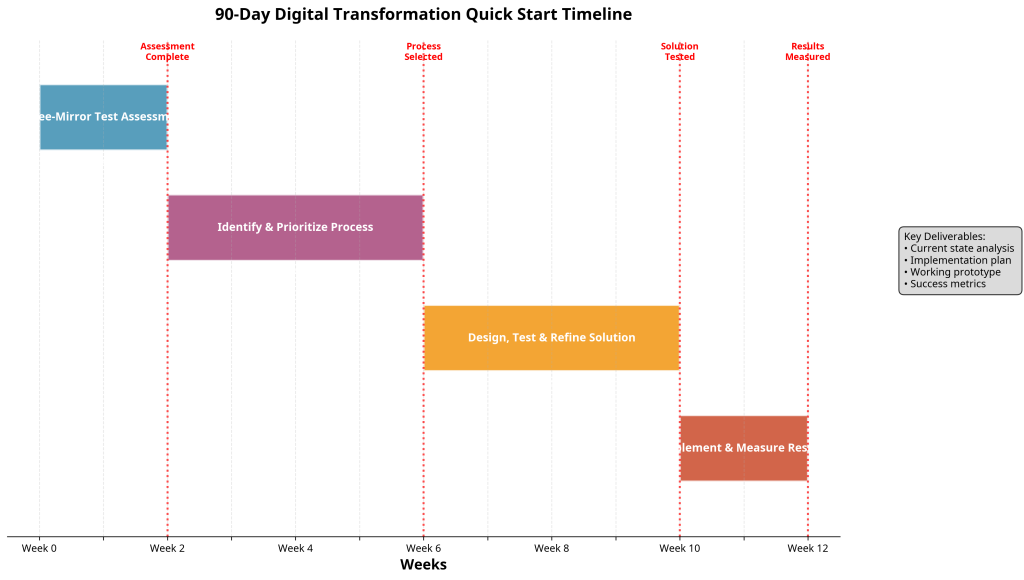
Organizations seeking to begin their digital transformation journey can implement a focused 90-day sprint that demonstrates value while building capabilities for larger transformation efforts. This approach, based on the successful methodologies used by organizations that achieve higher transformation success rates, emphasizes rapid learning and measurable results over comprehensive planning [31].
Weeks 1-2: Conduct Three-Mirror Test Assessment
Begin by implementing the Three-Mirror Test framework to establish a clear understanding of current state operations. Document every workflow ruthlessly, including the embarrassing workarounds that everyone pretends don’t exist. Map every customer touchpoint from their perspective, not your organizational chart’s perspective. Identify which processes directly impact profit margins versus those that simply make the organization feel busy.
This assessment should involve front-line employees who actually perform the work, as they often have the most accurate understanding of process realities. Create a “Transformation Graveyard” where you document every failed initiative from the past five years and study the patterns. Most failures stem from solving imaginary problems or implementing solutions nobody asked for [32].
Weeks 3-6: Identify and Prioritize One Broken Process
Select one genuinely broken process that meets three criteria: it directly impacts customer experience or revenue, it can be fixed completely within the 90-day timeframe, and success can be measured objectively. Resist the temptation to tackle multiple processes simultaneously—the goal is to demonstrate complete success rather than partial progress across multiple areas.
Design the solution with business outcomes as the primary driver, not technology features. The solution should eliminate the root cause of process failure rather than automating existing inefficiencies. Involve users in the design process to ensure the solution addresses real problems and can be adopted effectively.
Weeks 7-10: Design, Test, and Refine Solution
Implement the solution on a small scale with a representative user group. Test not only the technical functionality but also the change management approach, training materials, and support structures. Collect both quantitative performance data and qualitative user feedback to refine the solution before broader implementation.
Plan for failure and use setbacks as learning opportunities. The goal is to identify and resolve issues during the testing phase rather than discovering them during full implementation. Document all lessons learned and share them transparently with stakeholders to build trust and demonstrate commitment to continuous improvement.
Weeks 11-12: Implement, Measure, and Share Results
Deploy the solution completely—not 80% complete, but fully functional and optimized. Measure actual business results using the baseline data established during the assessment phase. Share both successes and failures publicly within the organization to demonstrate transparency and commitment to learning.
Use the results to build momentum for larger transformation efforts. Even modest improvements can demonstrate the value of systematic transformation approaches and build organizational confidence in more ambitious initiatives. Document the methodology used and create templates that can be applied to additional processes in subsequent 90-day sprints [33].
Future Outlook: Digital Transformation Trends 2026-2030
The digital transformation landscape continues to evolve rapidly, driven by emerging technologies, changing business models, and shifting competitive dynamics. Organizations planning transformation initiatives must consider these trends to ensure their strategies remain relevant and effective over the coming decade.
AI and Autonomous Systems Integration
Artificial intelligence is transitioning from experimental technology to foundational business capability. McKinsey’s 2026 analysis identifies AI as both a powerful technology wave and a foundational amplifier of other trends, accelerating progress within individual domains and unlocking new possibilities at intersections. Organizations will increasingly deploy AI not as standalone applications but as integrated capabilities that enhance human decision-making and automate routine processes [34].
Autonomous systems are moving from pilot projects to practical applications across industries. These systems are learning, adapting, and collaborating rather than simply executing predefined tasks. The rise of agentic AI—virtual coworkers that can autonomously plan and execute multistep workflows—represents a significant shift toward human-machine collaboration models that augment rather than replace human capabilities.
Infrastructure and Scaling Challenges
The surging demand for compute-intensive workloads, especially from generative AI, robotics, and immersive environments, is creating new demands on global infrastructure. Data center power constraints, physical network vulnerabilities, and rising compute demands have exposed significant gaps in current infrastructure capabilities. Organizations must plan for these scaling challenges as they design transformation strategies [35].
Supply chain delays, labor shortages, and regulatory friction around grid access and permitting are slowing technology deployments. Successful transformation strategies must account for these practical constraints and build flexibility to adapt to infrastructure limitations and opportunities.
Regional Competition and Sovereign Infrastructure
Global competition over critical technologies has intensified, with countries and corporations investing in sovereign infrastructure, localized chip fabrication, and national technology initiatives. This trend toward technological sovereignty affects supply chains, vendor selection, and strategic partnerships for multinational organizations.
Organizations must consider geopolitical factors in their transformation planning, including data sovereignty requirements, technology export restrictions, and supply chain resilience. The push for self-sufficiency in critical technologies creates both challenges and opportunities for organizations planning long-term transformation strategies [36].
Looking ahead, digital transformation trends point to continued investment with an 18% compound annual growth rate forecasted through 2030. Organizations that begin transformation efforts now, using proven frameworks and business-first approaches, will be better positioned to capitalize on emerging opportunities while avoiding the pitfalls that continue to trap the majority of transformation initiatives in failure [37].
Key Takeaways: Essential Principles for Digital Transformation Success
Based on comprehensive analysis of transformation patterns, authoritative research, and proven frameworks, several essential principles emerge for organizations seeking digital transformation success:
Transform thinking first, technology second. The most critical factor distinguishing successful transformations from failures is the sequence of change. Organizations that begin with business process redesign and cultural transformation, then select supporting technologies, achieve significantly higher success rates than those that start with technology implementation. The 84% failure rate primarily reflects technology-first approaches that digitize existing inefficiencies rather than enabling new business capabilities.
Focus on business outcomes, not technology features. Successful transformations establish specific, measurable business objectives before evaluating technology options. Instead of implementing AI because it’s innovative, successful organizations identify specific business problems that AI can solve and measure success through revenue impact, customer satisfaction improvement, or operational efficiency gains. This outcome-focused approach prevents the technology-for-technology’s-sake implementations that characterize most failed transformations.
Use proven frameworks and 90-day sprints. Organizations that adopt structured methodologies like the California Digital Strategy framework, McKinsey’s technology trends analysis, or the Three-Mirror Test achieve substantially higher success rates than those that develop ad hoc approaches. The 90-day sprint methodology enables rapid learning, demonstrates value quickly, and builds organizational confidence for larger transformation efforts. This approach reduces risk while accelerating time-to-value.
Measure success through revenue impact, not technology metrics. Traditional IT metrics like system uptime, user adoption rates, or feature utilization fail to capture transformation value. Successful organizations measure transformation success through business metrics: revenue growth, customer satisfaction scores, market share gains, or operational cost reductions. These business-focused measurements ensure that transformation efforts remain aligned with organizational objectives and demonstrate clear value to stakeholders [38].
References
[1] World Wide Technology. (2025, June 3). The $2.3 Trillion Question: Why 84% of Digital Transformations Still Fail. WWT Blog.
[2] Ibid.
[3] MyHub Intranet Solutions. (2025). Top Digital Transformation Statistics 2025: Market, ROI & Trends.
[4] Ibid.
[5] Statista. (2025). Global digital transformation spending 2027.
[6] McKinsey & Company. (2025, July 22). McKinsey technology trends outlook 2025.
[7] MyHub Intranet Solutions. (2025). Top Digital Transformation Statistics 2025: Market, ROI & Trends.
[8] Mordor Intelligence. (2025). Digital Transformation Market Size & Share Analysis – Growth Trends & Forecasts (2024 – 2029).
[9] MyHub Intranet Solutions. (2025). Top Digital Transformation Statistics 2025: Market, ROI & Trends.
[10] Ibid.
[11] Ibid.
[12] World Wide Technology. (2025, June 3). The $2.3 Trillion Question: Why 84% of Digital Transformations Still Fail. WWT Blog.
[13] Ibid.
[14] Ibid.
[15] Forbes Technology Council. (2024, April 18). Can GPT Improve Business Transformations’ Appalling Failure Rate?
[16] World Wide Technology. (2025, June 3). The $2.3 Trillion Question: Why 84% of Digital Transformations Still Fail. WWT Blog.
[17] Ibid.
[18] MyHub Intranet Solutions. (2025). Top Digital Transformation Statistics 2025: Market, ROI & Trends.
[19] World Wide Technology. (2025, June 3). The $2.3 Trillion Question: Why 84% of Digital Transformations Still Fail. WWT Blog.
[20] California Department of Technology. (2025). California State Digital Strategy.
[21] Ibid.
[22] McKinsey & Company. (2025, July 22). McKinsey technology trends outlook 2025.
[23] Ibid.
[24] World Wide Technology. (2025, June 3). The $2.3 Trillion Question: Why 84% of Digital Transformations Still Fail. WWT Blog.
[25] Ibid.
[26] McKinsey & Company. (2018, October 29). The keys to a successful digital transformation.
[27] Ibid.
[28] World Wide Technology. (2025, June 3). The $2.3 Trillion Question: Why 84% of Digital Transformations Still Fail. WWT Blog.
[29] McKinsey & Company. (2018, October 29). The keys to a successful digital transformation.
[30] California Department of Technology. (2025). California State Digital Strategy.
[31] World Wide Technology. (2025, June 3). The $2.3 Trillion Question: Why 84% of Digital Transformations Still Fail. WWT Blog.
[32] Ibid.
[33] Ibid.
[34] McKinsey & Company. (2025, July 22). McKinsey technology trends outlook 2025.
[35] Ibid.
[36] Ibid.
[37] MyHub Intranet Solutions. (2025). Top Digital Transformation Statistics 2025: Market, ROI & Trends.
[38] World Wide Technology. (2025, June 3). The $2.3 Trillion Question: Why 84% of Digital Transformations Still Fail. WWT Blog.