

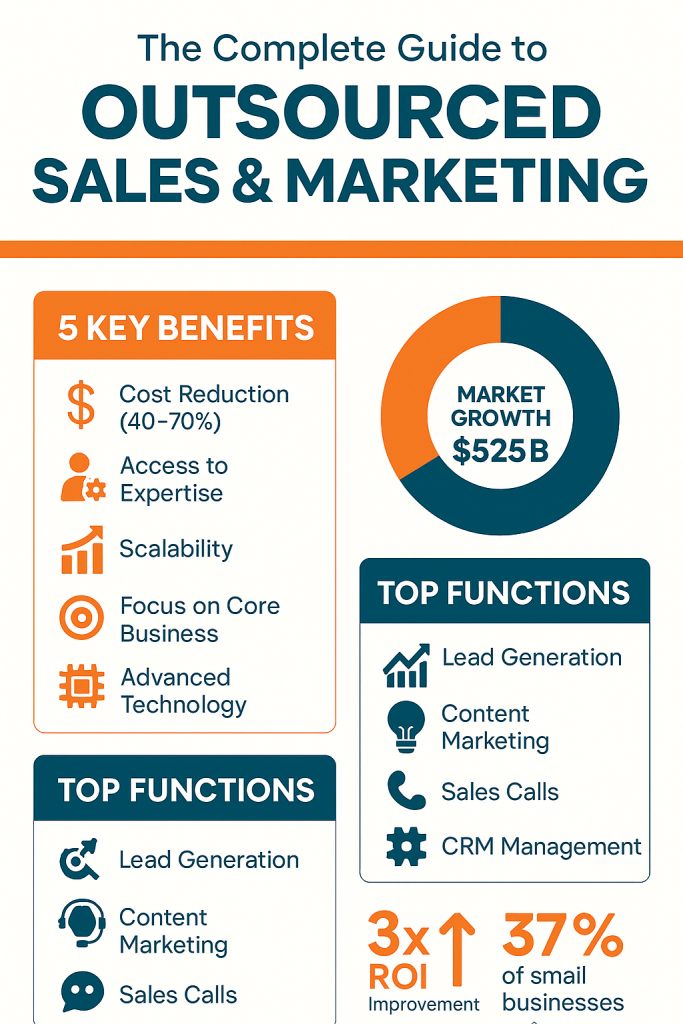
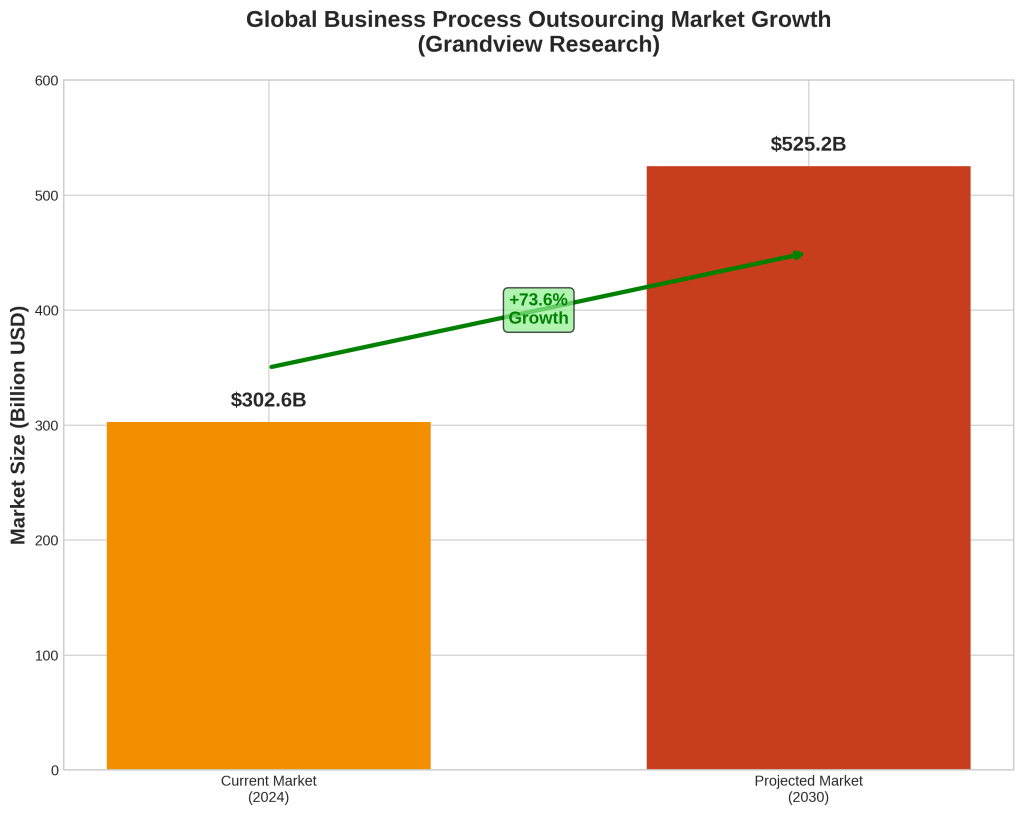
The global business landscape has witnessed a fundamental shift in how organizations approach sales and marketing operations. With the business process outsourcing market projected to reach $525.23 billion by 2030, representing a 73.6% growth from current levels, companies are increasingly recognizing outsourced sales and marketing as a strategic imperative rather than a cost-cutting measure. This comprehensive analysis examines the current state, benefits, challenges, and future trajectory of outsourced sales and marketing based on authoritative research from McKinsey, the Small Business Administration, and Bureau of Labor Statistics.
Market Context and Current Landscape
The outsourcing industry has undergone significant transformation over the past decade. According to McKinsey’s comprehensive analysis of business process outsourcing, companies worldwide spend an estimated $230 billion annually on managing business processes, with sales and marketing functions representing a substantial portion of this investment. The shift from traditional cost-focused outsourcing to strategic, technology-enabled partnerships has fundamentally altered the value proposition for businesses of all sizes.
Small Business Administration data reveals that more than one-third of small businesses currently outsource at least some of their operations, with marketing and sales ranking among the most commonly outsourced functions. This trend reflects a broader recognition that specialized expertise and advanced technologies can deliver superior results compared to in-house capabilities, particularly for resource-constrained organizations.
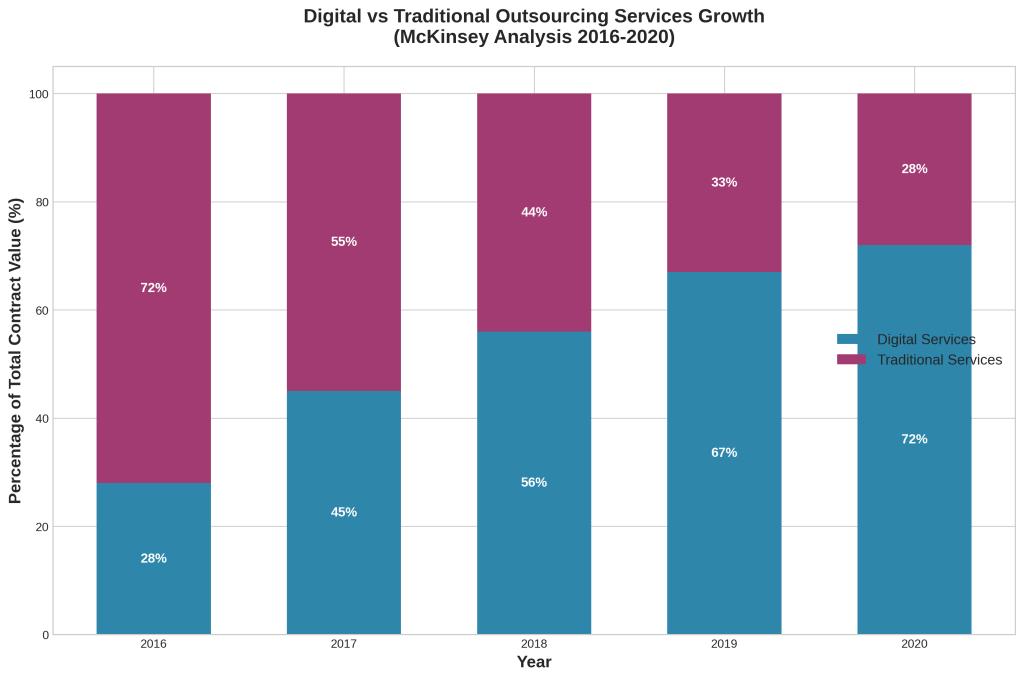
The digital transformation accelerated by the COVID-19 pandemic has further catalyzed this evolution. McKinsey’s analysis of 53 business-process-outsourcing deals between 2016 and 2020 demonstrates that digital services grew from 30% to 70% of total contract value, while the number of deals incorporating digital components nearly doubled over this period.
Quantified Benefits and Performance Metrics
The financial and operational advantages of outsourced sales and marketing are well-documented across multiple authoritative sources. McKinsey’s research indicates that digital-based outsourcing yields two to three times more impact than traditional models, while also improving the experience for buyers and their customers. This performance differential stems from several key factors that distinguish modern outsourcing arrangements from legacy approaches.
Cost optimization remains a primary driver, though the mechanisms have evolved beyond simple labor arbitrage. Companies outsourcing to the Philippines can achieve labor cost reductions of up to 70%, while maintaining access to a highly capable workforce with a 97% literacy rate. Similarly, organizations embracing modern outsourcing strategies can reduce operational costs by up to 40% according to Forrester’s 2024 analysis.
| Outsourcing Destination | Cost Savings | Key Advantages | Primary Functions |
|---|---|---|---|
| Philippines | 70% | High literacy rate, English proficiency | Customer service, sales calls |
| India | 65% | Technical expertise, scalability | IT support, digital marketing |
| China | 60% | Manufacturing integration, scale | Production support, logistics |
| Eastern Europe | 45% | Cultural alignment, time zones | Content creation, analysis |
Beyond cost considerations, outsourced sales and marketing provide access to specialized expertise and advanced technologies that would be prohibitively expensive to develop in-house. The global market for outsourced IT services alone reached $85.6 billion in 2019, reflecting the substantial investment organizations are making in external capabilities.
Strategic Implementation Framework
Successful outsourced sales and marketing initiatives require a structured approach that goes beyond traditional vendor selection. McKinsey’s analysis identifies four critical elements for next-generation outsourcing deals: transformation focus through digital capabilities, shared incentives aligned to innovation, collaborative partnership models, and outcome-based performance metrics.
The transformation focus represents a fundamental shift from transactional relationships to strategic partnerships. Rather than simply handing off well-defined tasks, organizations are increasingly outsourcing complex processes with providers taking responsibility for outcomes and deploying advanced technologies such as natural-language processing, robotic process automation, and artificial intelligence.
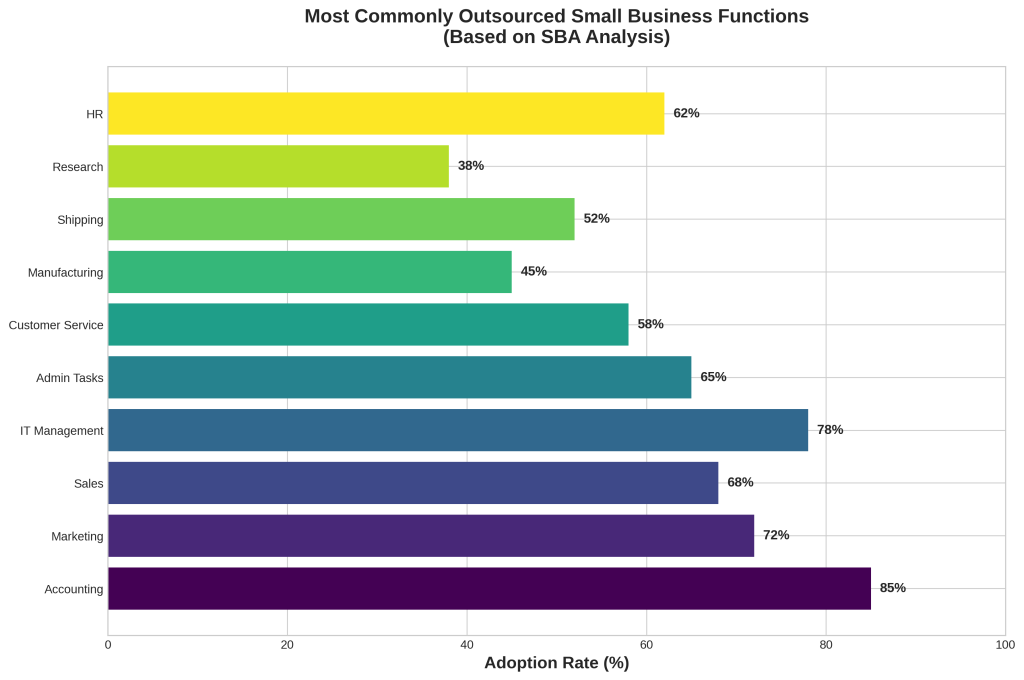
Small Business Administration research highlights the most commonly outsourced functions, providing a roadmap for organizations considering this strategic shift. Accounting leads the list as the most frequently outsourced function, followed by marketing, sales, and IT management. This prioritization reflects both the specialized expertise required and the potential for significant efficiency gains.
Challenges and Risk Mitigation
While the benefits of outsourced sales and marketing are substantial, organizations must navigate several challenges to achieve optimal outcomes. Bureau of Labor Statistics research on occupational homogeneity reveals that outsourcing trends contribute to wage inequality, particularly affecting lower-wage workers. This finding underscores the importance of considering broader economic impacts when making outsourcing decisions.
Communication challenges represent another significant risk factor. The physical and cultural distance inherent in many outsourcing arrangements can create coordination difficulties, particularly for complex sales processes requiring deep customer understanding. Organizations must invest in robust communication infrastructure and cultural alignment programs to mitigate these risks.
Data security and privacy concerns have become increasingly prominent as organizations share sensitive customer information with external providers. The regulatory landscape continues to evolve, with new requirements for data protection creating additional compliance obligations for both buyers and providers.
Future Outlook and Emerging Trends
The trajectory for outsourced sales and marketing points toward continued growth and sophistication. Grandview Research projects the global business process outsourcing market will expand at a compound annual growth rate of over 9% through 2030, with financial services, IT, and telecommunications driving the majority of this growth.
Forrester’s analysis of B2B sales trends indicates that buyers are increasingly digital-first, accelerating the need for technology-enabled sales and marketing capabilities. This shift creates opportunities for outsourcing providers to deliver value through advanced analytics, artificial intelligence, and automated customer engagement platforms.
The geographic distribution of outsourcing is also evolving. While traditional destinations like India and the Philippines continue to dominate, emerging markets in Latin America and Eastern Europe are gaining market share due to cultural alignment and favorable time zone considerations for North American and European clients.
Key Takeaways
- Market Growth: The global BPO market is projected to reach $525.23 billion by 2030, representing 73.6% growth from current levels, driven by digital transformation and strategic partnerships.
- Performance Impact: Digital-based outsourcing delivers 2-3 times more impact than traditional models, with modern strategies reducing operational costs by up to 40%.
- Adoption Rates: Over one-third of small businesses currently outsource operations, with 92% of G2000 companies utilizing IT outsourcing services.
- Strategic Evolution: The focus has shifted from cost reduction to strategic transformation, with shared incentives and outcome-based performance metrics becoming standard.
References
[1] McKinsey & Company. “Getting business process outsourcing right in a digital future.” February 15, 2022. https://www.mckinsey.com/capabilities/operations/our-insights/getting-business-process-outsourcing-right-in-a-digital-future
[2] U.S. Small Business Administration. “10 Small Business Functions That Can Be Easily Outsourced.” November 19, 2019. https://www.sba.gov/blog/10-small-business-functions-can-be-easily-outsourced
[3] U.S. Bureau of Labor Statistics. “Outsourcing, Occupationally Homogeneous Employers, and Wage Inequality in the United States.” Working Paper WP-522, 2022. https://www.bls.gov/osmr/research-papers/2020/ec200030.htm
[4] Grandview Research. “Business Process Outsourcing Market Report.” 2024. https://www.grandviewresearch.com/industry-analysis/business-process-outsourcing-bpo-market
[5] Exploding Topics. “47 New Outsourcing Statistics (2025-2027).” April 24, 2025. https://explodingtopics.com/blog/outsourcing-stats